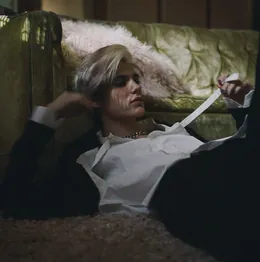
Hyvästi, isä
 |
| ebfhe | ebfhe | WC: 1894 | OOC Notes: "Hyvästi, isä" translates to "Goodbye, father" |
_____________________________________
K│ U│ L│ L│ E│ R│ V│ O│ |
The colour black was a staple that Kullervo had come to love in his artworks. Not because it was appealing, but because it was useful. It was a colour he used often when he painted - the colour he used to hollow out eyes, swallow mistakes, and make other colours appear more vibrant when beside it. He used it more than any other of his paints. Now, he wore it. Black pants and shoes, black button down, black coat that was too long across the shoulders, and a black tie to compliment the ensemble. His mother, Ainikki, had chosen these clothes for him as the boy never wore this much darkness all at once. Her own outfit mirrored his palette as she stood beside him over Eero Ikonen's freshly dug grave. Kullervo stood quietly, hands folded neatly behind his back, expression trained into something solemn and appropriate for the occasion. His father's death occurred in the middle of August, less than three weeks before he was intended to attend Durmstrang as a first year. The afternoon was warm - well, warmer than the usual harsh subarctic frost of northern Finland - and it felt wrong. The green of the Ikonen estate's backyard had yet to surrender to autumn, the alder trees were still heavy with leaves, bees weaved languidly throughout the bushes. And pale pink peonies bloomed around the grave. Kullervo could usually see these flowers through the window of the studio within the manor. He spent many afternoons in the spring and summer painting them - they were some of his only colourful works. He thought they were beautiful when he would transfer their likeness onto a canvas. But now, he was almost offended by them, he thought that they looked indecent. His father was dead; the world had no right to be beautiful. The grave itself was an ugly little thing. A simple polished headstone with Eero Ikonen carved into it in the center. Absurdly, Kullervo had thought that his father deserved something much grander. There should have been a chapel, black horses, bells, a crowd of people in dark coats standing shoulder to shoulder beneath a grey sky. There should have been speeches about his father's accomplishments by people who knew him better than Kullervo did to be able to say something meaningful. But there were no words that celebrated the life of his father, just his name carved into the rock to serve as proof he was even a real person at all, which would inevitably be eroded and taken by the years to come. Instead, there was only the garden. The manner stood behind him, its windows reflecting the burden of a colourless afternoon. Kullervo's mother instructed him to keep his back straight. So, he did, and straight it stayed. There was no formal ceremony. His mother said there was no need, that his father would have hated the spectacle. No family, no friends, no servants. Only them and the coffin that had been lowered into the ground some moments ago. Kullervo was never shown his father's body, the one that was supposedly confined within that sleek wooden box. Perhaps that's what made it so hard to believe that he was gone. Death became so abstract when one was denied proof of it and he couldn't make himself understand that it was his father inside the coffin that was being covered with soil by an enchanted shovel. Kullervo understood what had happened, he was not a child. He understood the definition of the word. He understood the practical consequences of the concept. He understood that his father's study would be emptied in due time, that his correspondence would become his mother's responsibility and partly his own, that the question of inheritance would eventually have to be settled. He understood that his father would no longer sit at the head of the dining table. He understood that the man whose approval he had once treated as sacred and precious was simply gone and he no longer had any reason to yearn for those ugly sentiments. But understanding was not the same as believing. His mother lowered her eyes to him. "Do you have anything you wish to say?" Kullervo slowly looked up at her. "No." She nodded. "Very well." The shovel made itself scarce once the grave had been completely buried over. Kullervo wondered if his father would have thought this burial to be acceptable. Probably not. It was too small. Too plain. Too close to the estate. He knew his father had always despised things that suggested humility. Kullervo swallowed thickly, his throat feeling strangely tight. He straightened his shoulders and he noticed his mother noticing. "Are you cold?" She asked him. "No." "You are trembling." Kullervo then looked down at his hands. They were shaking. Only slightly. It was currently summer in Finland. Not that it made a difference, for the north of the country rarely surpassed freezing point, even in the warmer seasons. It was still cold. But that is not why he was trembling. He curled his hands into fists, his brows creasing together. "I am not." His mother said nothing and somehow that made it worse. Silence ensued. Kullervo's father had never been kind; the boy knew that. He knew it with the same certainty with which he knew the texture of a canvas, or how certain pigments mixed together. His father had been exacting, severe, fastidious. He was a man who believed affection was something only spoiled children, women, and weak men required and, to him, Kullervo should be none of those things. Kullervo had spent his entire childhood becoming someone worthy of his approval. He had succeeded. Or so he thought. For just half a second, he thought. Believing it was the most foolish thing he had done. Because now, there was nothing left to prove, nothing to be worthy of. That frightened him. What was he without expectation? Kullervo looked to his mother again. She was staring quietly at the grave. And for the first time, Kullervo noticed she looked old. Not in years - although, she certainly did not have Kullervo young - but just... tired. To him, she seemed smaller without his father next to her. Kullervo almost reached for her hand. Almost. Then he remembered himself. His father once told him when he was littler that crying was an indulgence and one was not to mindlessly indulge. That was a weakness. When Kullervo would cry over smaller trivial things, his father looked at him with something between disgust and disappointment. He was told to compose himself. So, Kullervo always did. Now was not much different. Except there hadn't been any tears to begin with, from neither him nor his mother. Kullervo thinks she understood that his father was a difficult man, that perhaps he didn't know how to be anything else. He didn't know what angered him more; the action or inaction. "Hyvästi, isä. Goodbye, father." Kullervo's voice came out quiet, but it did not break, it did not tremble. It was perfectly controlled while something much heavier settled beneath. He felt his mother's hand on his shoulder. "Do not miss him, Kullervo. Honour him." Kullervo felt something disgusting and painful twist behind his ribs. He did not know what it was, only that he was not fond of the sensation. But he took his mother's words as law. To miss someone was to remain attached to something that was gone, to cling to ghost stories and fables, and his father was not someone to be mourned in that way. But when he looked towards the grave, his mother's words settled deep within him and took root. Honour him. There was no comfort nor sentiment in the word, no love nor memory. It was a duty. A new expectation, something for Kullervo to accomplish, to put his mind to. Grief was unbecoming when outwardly displayed, he was often told as a child. He never really understood it until now. Now, he understood that it was because grief made one appear weak. Powerless. Kullervo refused to be weak. He wouldn't be powerless, not now, not ever. That strange sensation in his chest remained as he kept his intense glare on the grave. In his mind, Kullervo would name the feeling as loyalty. He had no other word for it. Kullervo made a vow to himself that afternoon. He would become greater than Eero Ikonen. He would become harder. More disciplined. More accomplished. He would never allow himself any weakness. He would never be pitied. Never be dependent. Never be soft. If he were to honour his father, Kullervo would have to become incapable of grieving. - The first thing Kullervo did after the funeral was enter his father's study for the first time in his eleven years. Kullervo almost didn't get passed the grand door, clutching his brush against the tube of black paint so hard the pigment almost spurted out, all until he remembered those two words. Honour him. And nobody stopped him when he put his mind to it. The room retained the scent of tobacco, coffee, and old parchment. One of his father's coats was draped over the seat. A mug was sat on the desk, undisturbed, half empty, holding down an unfinished letter. Kullervo waited, as though he would have some great revelation of death, as if standing there in this sacred space he was never allowed inside would somehow make him finally understand his father. But nothing happened. And didn't have the time in his mind to take it all in. His mission was singular. He head directly for the grand portrait that was situated on the wall behind the desk, above a mantlepiece and between shelves with numerous antiques displayed on them. The portrait didn't seem so cold and dead in the eyes as the man did in person when it looked at him. Kullervo's gaze wandered down to the hands that were painted to be neatly folded over each other. The same hands that corrected his posture, that pointed to his mistakes, that, once, when he was incredibly young, rested briefly atop his head. Kullervo did not know why he remembered the weight of that hand atop his head. He hated that he remembered. Do not miss him. Honour him. Kullervo reached up, unhooked the gilded frame, and carefully lowered it to his level. Not once had his father ever looked at him eye to eye like this. That's how he knew it wasn't his father. That's how he was able to take the tube of black paint and squeeze a splotch out over the icy eyes. And without crying, Kullervo took the brush and dipped it in the black. He dragged it across the canvas, rough and unfiltered, hard enough to split the bristles. Not with his usual poise as when he would paint his landscapes of the bleak midwinter. He repeated the action once. Twice. And again, until the black swallowed the eyes completely. Kullervo didn't know how exactly this was supposed to honour his father, but he knew that he could not stop once he had started. And, beneath the frostbitten anger over his own weakness, a vow had formed. Kullervo Ikonen, someday, somehow, would honour his father whether it was the last thing he did. "Hyvästi, isä. Goodbye, father." |
│I │K │O │N │E │N |