
Hearing Horns: Wizarding Hearing Aids
Hearing Horns: Wizarding Hearing Aids
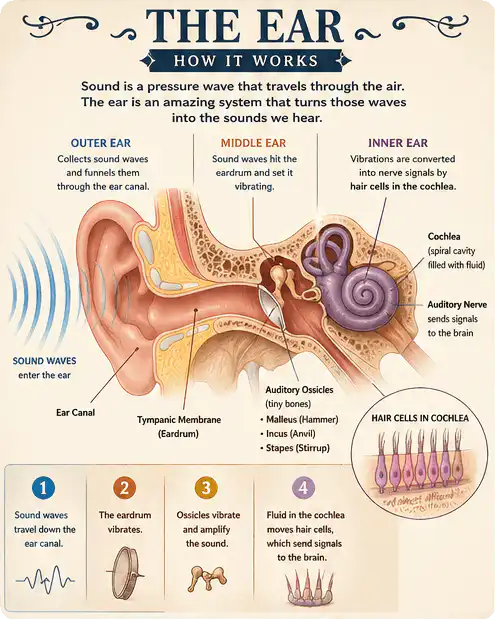
THE EAR The design of the ear is quite wonderful! We live within an air atmosphere the molecules of which vibrate when a source of sound initiates the wave of sound. This is essentially a pressure wave that moves through the air. When this wave approaches our outer ears, the waves of sound are collected and funneled through the ear canal.
Deep down inside a person's skull lies the middle and inner ears. It is here in the middle ear that the sound wave meets the tympanic membrane, or ear drum. This is a very thin piece of tissue that moves whenever sound waves strike it. Many things vibrate in the presence of sound, but this is where ears become quite astonishing! The tympanic membrane has attached to it a chain of very tiny bones called the auditory ossicles: malleus (hammer), incus (anvil), and stapes (stirrup). As the ossicles vibrate and amplify the sound, the stapes, which is attached to an opening into the inner ear, or cochlea, causes the fluid within to vibrate.
The movement of the fluid in turn causes very tiny hairlike cells to move, very much like how water plants sway with the current. These hairs line the cochlea, which is a spiral cavity within the skull and respond to different frequencies of sound. There is one auditory system on each side of the body, corresponding to the left and right ears.SOUND Healthy ears can hear tones (sounds that the brain interprets as a musical sound) as low as about 16 Hz and as high as 20,000 Hz --- that is 16 to 20,000 beats per second. We are actually quite capable of "hearing" lower frequencies, but they don't really translate into musical tones.
16 Hz is approximately the note C0, four octaves below middle c on the piano. A flute or an organ pipe that can play this pitch needs to be thirty-two feet in length. Two organs in the world, one in America and one in Australia, can play tones one octave below this, requiring the lowest pipe to be sixty-four feet in length, or 20 meters.
Don't fret if you can't hear the 20k! As with vision, hearing also decreases with age! Most people in their 20s can hear perhaps up to 17,000 Hz; through the 40s and 50s, this will decrease down to about 12,000 Hz.
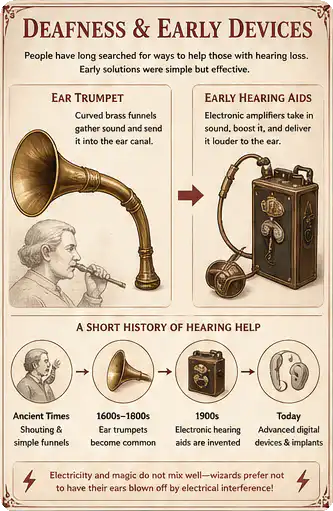
DEAFNESS Certain forms of deafness in the Muggle world can be remedied with a variety of devices. Throughout history, Muggles --- and wizarding folk too, if we're quite honest --- have resorted to shouting very loudly at deaf people (never works), to devising simple devices like ear trumpets. These are small curved brass funnels, often nicely decorated, that allow sound to be gathered and sent in a concentrated fashion down into the ear canal.
These were replaced in modern times with hearing aids, which are small electronic amplifiers that essentially take external sound inputs, convert them through an amplifier and shout very loudly down the patient's ear canal. What was once a simple physical device, used by muggles and magical folk alike evolved in the muggle world into an electronic device unavailable to magical folk.
Largely because electricity is highly suspicious and wizards seem to prefer not having their ears blown off every time magic and electricity interfere.
An early attempt at an improved hearing trumpet was made by Irish witch Neilí Pluincéad (made famous even among Muggles for having survived the gruesome deaths of her family in a castle full of boiling water, and immortalized by the Great Bard Toirdhealbhach Ó Cearbhalláin). She went on to marry a Scottish wizard, Ian MacDonald, who chronicled the sittings and acts of the Wizengamot. Complaining that too many of the wizards in attendance shouted at the speakers and too many of the speakers mumbled, Neilí created a device that combined the usefulness of the omnioculars with a set of charmed hearing trumpets. Whilst the device was overall successful, MacDonald complained that the tin horns made the speakers sound like jabbering pixies singing the Chudley Canons fight song down a well.
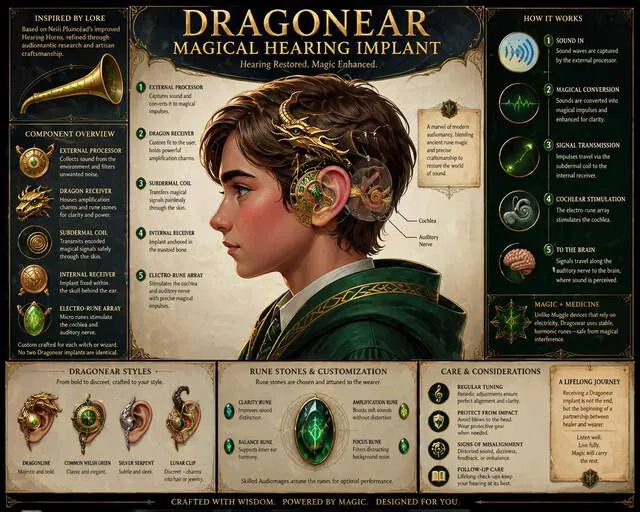
Newer and more improved models of the basic Plunkett Hearing Horn are now made with far better amplification charms and much improved styling. The image here depicts the Common Welsh Green model. A wide variety of such wearable hearing aids are made from showpieces such as the dragons line, to smaller and more discrete models that can be charmed into a hair clip or an ear ring even. Some wearers of very small, cheaply made items complain of reduced sound quality, but there are certainly valid reasons for this option. Skilled audiomages can transfigure a hearing horn into nearly any shape and size that a person might want.
Muggles and wizarding folk alike also suffer from more profound forms of hearing loss, such as sensoryneural hearing loss. In this case there is damage to the inner ear and the deafness is considered to be permanent. Muggle hearing aids and voice amplification charms alike fail to resolve the issue, and such patients often suffer lifelong inability to interpret vocal or audible speech. In order to solve this problem Muggles, as Muggles often do, have resorted to what they call "electronic wizardry" in the form of a cochlear implant. This is a device that transmits sound waves into a device surgically implanted in the skull which then sends electrical signals along an electrode into the inner ear. The signals stimulate the auditory nerve which allows users to hear again.
A highly skilled magical surgeon, specializing in diseases of ears, eyes, noses, and throats, is called in to fashion and fit the wizarding analogue of the cochlear implant, or "dragonear" as many call it. Like its muggle counterpart, there is an outer portion that receives the sound waves. These in turn interact with a highly complex array of diminutive rune stones which act upon a twin array of rune stones set into the bone of the wizard's skull. When properly synched by a Runemage, these arrays set up impulses upon a super thin tube enclosing a magical core that is inserted through the bone and down into the cochlea. The excitation of the tube's core stimulates the auditory nerve, and allows a formerly deaf witch or wizard to hear again.
Most specialists agree that such devices should not be implanted in small children, under the age of about two due to the complexities of the magical surgery involved. This is very advanced magic and technically difficult surgery. While it's true that muggle surgeons perform such implantations on children less than one year old, wizarding surgeons caution against the risk to children so young.WEAR & TEAR The active life of many wizards demands a heavy toll on any device, magical or mundane, that they may use in daily life. Hearing horns of any kind are no exception! Even the simplest device needs to be properly set up and charmed by an audiomage. The more complex devices that are implanted within the body require more specialized maintenance.
Common complaints about implanted hearing horns include diminished ability to discern speech, too low or too high volume, random banshee-like screeching, transient nausea, and balance problems. In some rare cases, wizards have been known to use temporary sticking charms on their socks in order to walk on the ceiling in an attempt to alleviate their symptoms! Others have taken to talking to the "banshees" they swear are living in their heads.
Thankfully, most of the negative symptoms of wearing a hearing horn can be avoided, ameliorated, or even completely done away with by the simple expedient of paying a visit to their surgeon! Such highly complex magical devices require precise alignment and tweaking of components when first fashioned. It only makes sense that they will require periodic adjustments, degoosing, and fine tuning over the course of the device's lifespan. On occasion, runes might need to be realigned or replaced entirely. These services are recommended by St Mungos as well as the Ministry of Magic's medical department.
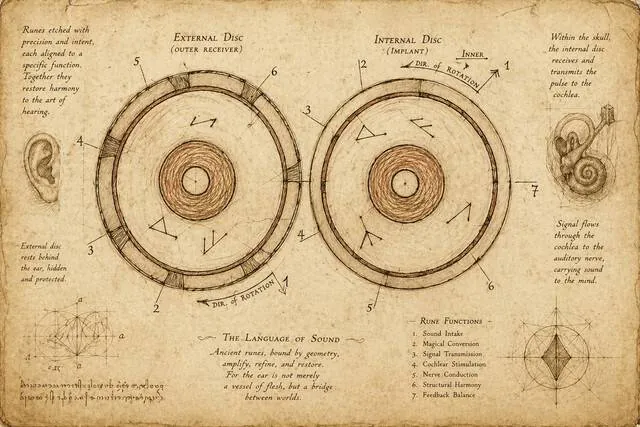
Hearing Dragon, showing the Inner and Outer Rings of the device along with their respective Runes.PATIENT INFORMATION
General
The following outlines several key areas for you and your family to be aware of once you have a hearing horn implanted. Each runesmith and hornwright have their own specific guidelines which can be found by addressing an owl to the maker of your horn. Following are some things to bear in mind regardless of the specifics of your hearing horn.
Significant Bumps and Falls
It is important to be aware that any significant knocks or bumps to the implant site can cause certain complications, such as clash screeching, which occurs when the spinning disks crash against the device housing and squeal until the runes reset the disk alignment. Although quite robust, implants can break so be aware of this when participating in activities where this could occur. For example, it is not recommended to use a hearing horn as a safety device whilst playing quidditch. It can take a fairly strong knock, but direct hit from a bludger will crush the external portions. Most normal wizarding activities such as dark wizard hunting or dragon taming post no serious risk to hearing horn. Some sort of helmet is recommended for those who participate in any broom sports such as racing, quidditch, quodpot, camanacht (pole surfing), etc.
Medical Procedures
Over the course of time, you may need to have hag slugs extirpated or an accidental splinching unsplunch, or a cursed object extracted from your face. These may necessitate your mediwizard or healer to use a diagnostic device that itself relies on inscribed runes or runestones to function. Usually these devices do not interfere with the function of hearing horns, however, there can be instances where such interference occurs. For example, if you notice that your teeth have unexpectedly turned green or that you're suddenly hearing echoes of speech or music, a sign of disk misalignment, kindly notify your local healing clinic.
Forces: Electricity / Magnetism / Gravitation / Magical
After implantation, it may be recommended to avoid certain Muggle items such as van der Graaf generators and power plants. It is also advised to be careful when diving, extreme broom sports, and whilst flying upon hippogryffs.
Muggle Security Systems
When travelling through airport security, it is advised not to walk through their "security scanners", which are easily recognized by their large boxy shape, much like a telephone box with flashing lights, but instead to request the use of a "hand scanner". We have, as yet, not been able to determine why Muggle police need to scan one's hands, but as we all know, Muggles do some weird things indeed! Also, it is absolutely imperative that you not refer to your device as "magical" or by the name "hearing horn".
Other Issues
External portions of the device may receive periodic upgrades, some stylistic, others functional, from time to time. Usually the makers of hearing horns will advertise through trade publications (such as MAGIC: the Journal of the Magical Audiology and Gastro-Intestinal Consortium) and ordinary media such as Witch Weekly, MagiTech Today, and the Daily Prophet. As with any complex charmed device of this sort, the lifespan of your device can not be determined with accuracy and it may be necessary to replace the internal components of the device at some point in your future.CLINICAL INFORMATION
General Considerations
The implantation of a hearing horn involves a team of people with a broad range of training and skills. This team includes specially trained ear, eye, nose and throat (EENT) mediwizards, magiaudiologists, as well as runesmiths and charmed artifact makers. Other specialists might also be consulted on a case as needed.
Implantation of a hearing horn is a highly specialized procedure, not performed by all mediwizards in all clinics. Implants of this sort are a specialized intervention undertaken by individuals who have chosen to specialize in hearing disorders and in the planning, construction, and implantation of charmed devices. Unlike other interventions, a hearing horn implant is but one part of a life long process that requires care over a patient's lifetime. The best outcome is dependent upon more than just surgery. Mapping and tuning of the inscribes runes by a magiaudiologist is required at the beginning, and the disks upon which the runes are engraved may need periodic servicing and realignment, usually every 3 months during the first year. After the first year, annual magiaudiology visits are recommended. Rehabilitation services and one on one teaching plans may also be required, especially for children.
Assessment
The first step in the evaluation process is to perform a pure-tone audiogram taken with and without mundane and magical external hearing aids. The audiogram determines the type and degree of the hearing loss and can indicate the origin of the patient's hearing loss and whether it originates in the inner ear or elsewhere. The severity of the hearing loss is reflected by the pure tone average hearing thresholds. This information serves as a key parameter in the decision regarding whether an individual candidate meets the magiaudiological criteria for hearing horn implantation. Information regarding which sounds are perceived best by a surgical candidate is reflected by the shape of the audiogram. The audiogram also enables the magiaudiologist to compare the patient's hearing in both ears, with aided and unaided outcomes. It is helpful for individuals undergoing an evaluation to have and share past medical records. Comparison of magiaudiograms over time can indicate whether the hearing loss is stable, fluctuating, or progressive.
Considering Bilateral Implantation
Many hearing horn implant patients have residual hearing in the non-implanted ear. To provide binaural and more balanced hearing a normal charmed hearing aid in the opposite ear may provide benefit. For individuals with a more severe hearing loss and minimal benefit from a hearing aid, a second hearing horn implant may be recommended. Binaural hearing offers the benefit of improved speech perception in noise (and quiet), better sound localization and greater access to sound generally.
Medical Assessment and Surgery
The medical assessment addresses the candidate’s overall health, hearing loss history, and etiology of the hearing loss. The wizarding surgeon will examine the condition of the ear and cochlea. Runological testing will be performed prior to surgery to allow visualization of the cochlear anatomy. The implant surgery itself will be performed with the use of anesthetic potions and generally takes two to three hours. The surgery is typically performed in a hospital setting with an overnight stay. Patients typically return for a follow-up appointment once week post surgery.
Postoperative Magiaudiology Appointments
Two to four weeks after surgery, the patient is fit with the external part of the hearing horn implant, which is called the dragon. A hearing magiaudiologist uses a complex assortment of runic devices to tune each of the individual disks and other components to levels that allow the recipient to best hear sounds. The process is similar to a normal hearing test in which a patient listens to the sounds of singing frogs, screechsnaps, roaring dandelions and so forth to determine the most comfortable and effective level of sound for the individual. These levels are inscribed within the external disk contained within the dragon. This information is often referred to as a "map". After the magiaudiologist measures and inscribes this information, the dragon is activated by the touch of one's wand and the patient hears with a cochlear implant for the first time.
Several appointments may be needed after this initial activation to adjust the spin rates of the disks and their alignment as patients adapt to sound and practice listening with the device. The number of appointments needed varies by the individual but is typically 3 to 6 appointments the first year and one appointment per year after that.
The Device
The implanted device itself comprises two housings, one implanted, and one external, within which reside two spinning disks. Carefully chosen runes are meticulously engraved upon the disks which have previously been trigonometrically & arithmetically mapped out. The counter rotational movement of the disks allows sounds to be translated into magical potentials, the signals of which translate the exterior sound into pulses that directly stimulate the hearing cells within the cochlea.
On the exterior side, the dragon collects and preprocesses the sounds. On the interior side, the signals from outside travel along thin filaments which are inserted into the cochlea causing the cells to be stimulated, bypassing the normal process of hearing.Lore by Colin McCoire
This is the "Game Master" account. Please do not owl this account, unless specified. This account is not moderated actively and therefore, you may not receive a response.
Contact a Head of House or the Headmaster if you need anything.