
Isle of Divination
The Isle of DivinationLocated in the Celebes Sea, the Isle of Divination is a magical island hidden with protective enchantments of ancient times. This page serves as a compendium of the written lore and descriptions of each of its wonderous locations. Journey through the jungle and find within it, the four unique communities and settlements nestled within the vibrant nature.
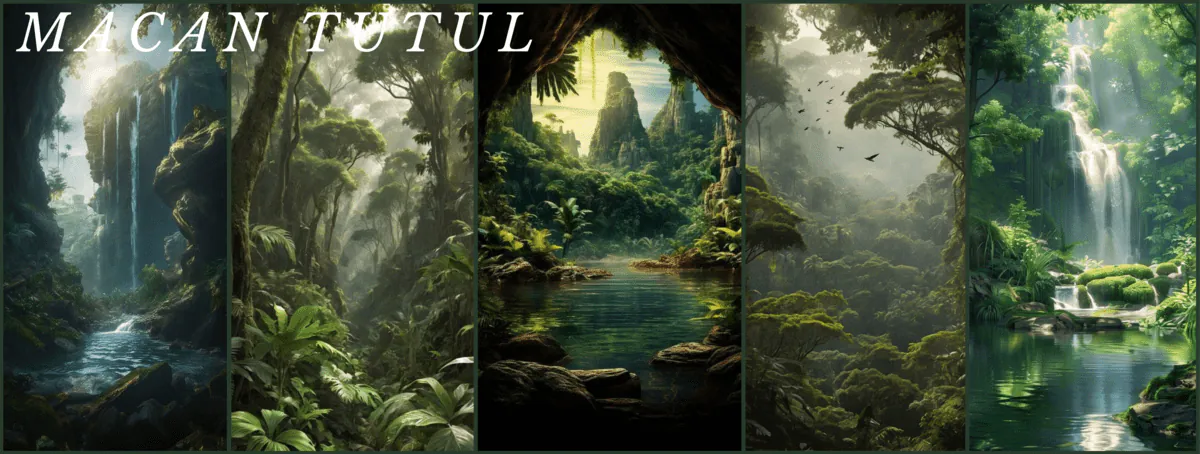
Macan TutulMacan Tutul, named after the founder of the Isle for his leopard animagus form, was a blessed union of magic and nature home to many diverse and vibrant species. The Isle itself was not entirely covered in jungle, with gorgeous golden and white sand beaches, lagoons and caves it was a testament to the incredulous power of nature. The jungle itself though was a dense, coated area with intertwining flora covering the majority of the floor. Footways from each of the four cardinal points would lead you through the mysterious forestry, through thick fogs and swamps, past waterfalls and sheer cliff faces to the heart of the jungle where Tenūsa resided.
Vines crawled up the side of the various species of trees such as Teak, Mahogany, Meranti, Balsa, Acacia, Rubber Trees, Sengon and the Banyan trees that could reach up to 100 feet in height. Such biodiversity in all plant life gave Macan Tutul an otherworldly feel, and their refusal to defy the natural law of the Isle allowed it to thrive under the people’s protection. Entirely sustained the tropical climate of the region meant that high temperatures could soar and thus clothing was often enchanted on the island with cooling charms. This climate also fostered abundant rainfall allowing for rapid plant growth, making the jungle retain a lush, healthy appearance.
Home to not only an incredible range of plant species, the biodiversity of the jungle was sustainable for a great number of creatures both magical and mundane. Left mostly to their own devices, the island would provide them with everything they needed much like it did the inhabitants. Having been entirely created by magic, some believed the Isle of Divination to be its own living organism and as such it is treated with dedicated respect. Every fibre and leaf, every drop of water was an extension of the island and an extension of that magic and thus should be respected. Much like how every creature, even a fly, was to be treated the same. The natural cycle was the fundamentals of Isle life.
When in bloom islanders could often discover the rare rafflesia flower, the world's largest, and revel in its beauty. With its bright red colour and unusual spots, one might mistake it for a magical plant and perhaps even once it was, but now commonly known in the muggle world any magical properties of the past are lost to the ages.
Making your way through the gorgeous expanse of wildlife many are often drawn to the serene symphony of sounds the jungle creates. From the chirping of insects to the songs of the birds, the soft trudge of sand and mud beneath your feet and the rustle of leaves it was a sound bath of tranquillity. Rich earthy smells would enhance the experience until you neared one of the four villages of the island where aromatic spices would fill the air, the culinary arts on full display for all the senses.
With areas of dense canopy there were a great deal of shaded areas across the span of the jungle but when light winds would blow, glittering sunlight would filter though the leaves creating a dazzling effect of light dancing through the forest itself. No matter where you found yourself in Macan Tutul it was a wondrous sight. Surrounded by trees, swimming in a lagoon by the shores, hiking a mountain or refreshing yourself under a cascading waterfall it was a place of natural harmony exempt from the ruin of deforestation.
_____________________________________________________________
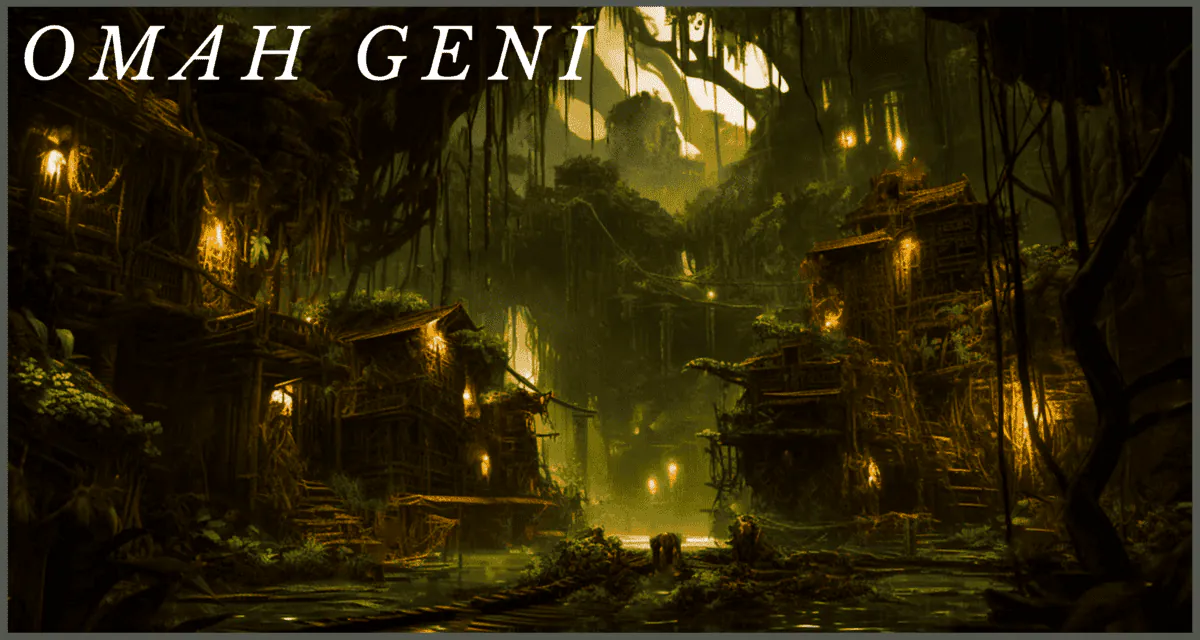
Omah GeniLike all structures on the isle, the village of Omah Geni is made from the diverse types of wood that make up the vast forests of Macan Tutul as well as other materials local to the island such as stone, clay, palm fibres, thatch, and bamboo. Shacks, huts, and even old fishing boats are constructed on top of older buildings, which creates a large mesh of houses overgrown with the jungle’s wild flora. Built into existing land masses rather than terraforming the area, the local people of Omah Geni bow to the natural order of the island in the knowledge that they belong to the island, the island does not belong to them. Dukun, those with pewari and those without, live throughout the township, as do families whose children are undertaking their group education.
Located in the densest part of the jungle Omah Geni is almost entirely blocked off from sunlight due to the overhanging canopies of trees and almost cavernous area in which it resides. Yet there are portions of the village that have nothing but clear blue skies above with towering cliffs on either side. Built into the mountain walls, stone stairways can be used to climb to the upper layers of the village and beyond to the main academic buildings of Tenūsa, though many classes take place in the village itself. With the thick foliage above, Omah Geni makes use of beautiful, coloured lanterns to illuminate the homes, shops and walkways, crafted with bamboo or wooden frames that are then covered in paper or silk, with candles or oil lamps within.
With areas of swamp or marsh like terrain spread across the jungle floor, wooden walkways are implemented so that the villagers may cross these areas without trouble. These walkways create a lattice across the marshland that allow local herbologists to grow and cultivate the areas magically. In fact, all across Omah Geni there are herbology marvels in the growing of flora creating pockets of stunning colour in among the mostly green expanse. The town is also well known for its medicinal and potion practices and often locals from the other villages will make the journey to Omah Geni when they require assistance as many great healers and potioneers call the village their home.
Much like Hogsmeade, Omah Geni hosts a number of vendors in which students and locals alike can buy basic supplies as well as culinary places such as Tari Lenso. Named after a Maluku dance it offers a range of Southeast Asian cuisine and hosts artistic events most nights with dancing, art, theatre and music. While the students from Oceania can be transported home in Charcoal Lane, a grill house making use of native aboriginal and Torres Strait Islander techniques. Blending native flavours with traditional Aussie and Kiwi comfort foods, it is a home away from home and offers culinary classes and training to those willing to learn.
Gifted by a crafter from Nephila Pilipes, a mesmerising stained glass aviary can be found in the centre of the village where the sun can shine down upon its sparkling rays of sun off the glass. It is home to a number of tropical and exotic birds of a wide spectrum of colour and sizes that can be used much like owls in the western world. From Hawks to hornbills and kingfishers to cockatoos the aviary hosts a great many species magical and otherwise, living harmoniously with shamans who specialise in keeping them safe and protected. The large stained-glass dome itself features illustrations of the supposed creation of the Isle and the story of Macan Tutul, its founder.
_____________________________________________________________
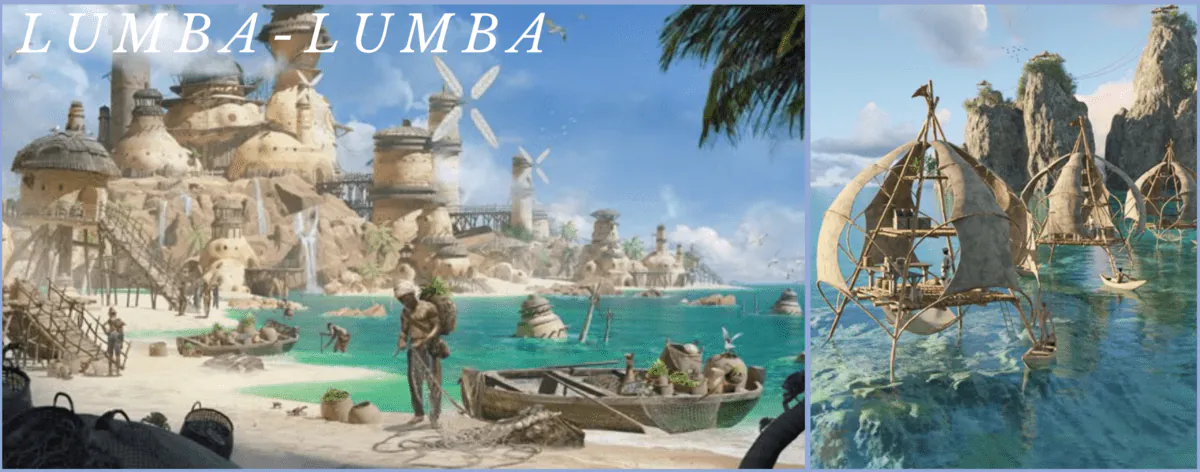
Lumba-LumbaThe coastal fishing village of Lumba-Lumba (Dolphin) and its bajau inhabitants make use of the warm southern sands for their home, creating a sanctuary of relaxation and tranquillity. Working with the natural dunes and rock formations of the shore their village of clay, thatch and mangrove wood blends seamlessly into the terrain with overlapping houses towering above each other. Others, preferring to be directly connected to the sea, build floating foundations in the turquoise waters themselves. While the village is their primary home, bajau dukuns and their families also operate the four cardinal harbours of the Isle overseeing all who come to the island by sea.
On the gorgeous white sand beaches the local people sell small goods, like shells, seaweed and more rare treasures related to the sea. Across the shore local children contribute to the community by washing clothes together or preparing food, but can often be found playing games in the mesmerising lagoons and beaches. Being one of the few places unaffected by the Isle’s protective enchantments the waters here are peaceful enough for light water sports and in the surrounding depths a most luminous coral reef can be found. Situated further out in the water are small outposts of wood and cloth strategically placed in areas where the current can ferry fish straight into their nets. While for the majority of time the process is done without magic to preserve the natural balance of the world, occasionally large schools of fish might be drawn out of the water with spellwork due to necessity.
On the outskirts of the village, within the jungle was a flat area of fertile land that spanned fields of crops allowing the local people to farm all sorts of fruits and vegetables aided by skilled shaman herbologists. With flooded farmland for rice and tall banana and coconut trees, Lumba-Lumba was a paradise students could travel to when the constant vegetation of the jungle and stress of schooling became too much. On a clear night the beach was the perfect location to gaze at the stars with the infamous Delphinus or Lumba-Lumba constellation the village was named after shining above, glinting down on the tranquil waves.
Each harbour of the Isle was not only a base point for incoming students and visitors to take their journey into Macan Tutul but an additional fishing post to easily supply enough for the entire island. For much like the fliers of Elang Jawa the nomadic bajau shaman would often take the journey to retrieve students for their apprenticeship, using their mastery over the sea to bring them to their new home.
_____________________________________________________________
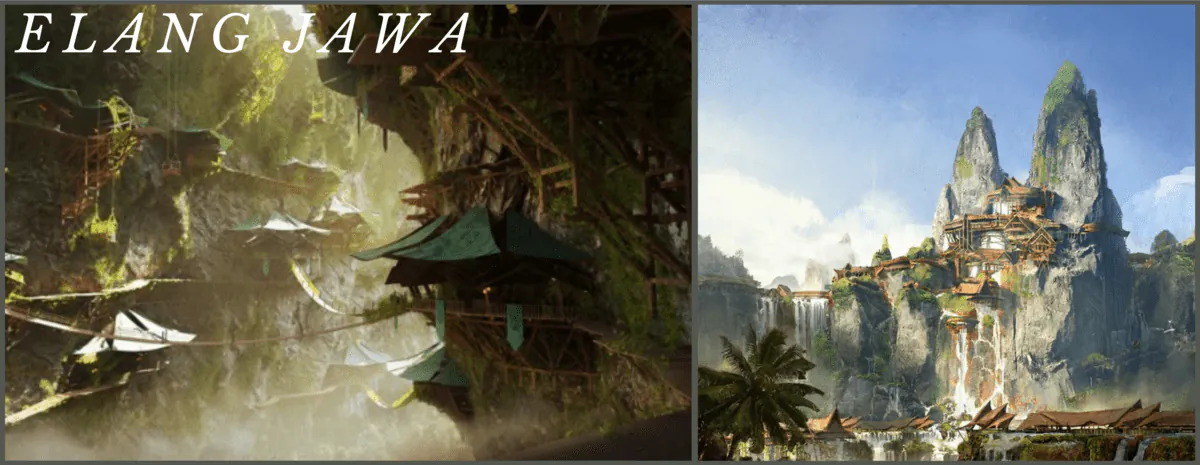
Elang JawaTowering high above the jungle in the treacherous peaks the island provides lies the village of Elang Jawa (The Javan Hawk Eagle). A settlement built into the mountain side of the highest of the Isle of Divinations peaks. Here miles above the rest of the world, houses are suspended in the air attached to the mountain edges. Not for the faint of heart, the only navigation around this aerial village is by broom or by crossing the enchanted rope bridges that stretch hundreds of miles above the jungle floor. Enchanted to defend against all weather conditions, they are entirely safe but have still been known to cause many to pass out in fear. Given the grand altitude and its breaching above the treeline, it is the ultimate place to gain a scope over the entire island in all its magnificence.
Responsible for the conservation and cultivation efforts of the island, the people of Elang Jawa survey the entire island both by air and ground to preserve the Isle and keep its inhabitants safe. Given what the tribe are directly responsible for, they often work with Dukuns to lead excursions and lessons on the care of the magical creatures using their specialised knowledge of the island and its inhabitants both creature and being alike. They see the Isle not only as their home but as the magic that created it, the magic that grows every leaf and blossoms every flower. They are a deeply respectful people and acknowledge the blessing Macan and his pewari provided in establishing this place.
However, this suspended village is not only known for its devotion to the isle, for beside their work the people of Elang Jawa are known for their thrill-seeking attitude and adrenaline chasing spirit. Up in the heights of the mountains the quidditch and broom racing course can be found. Weaving in between the peaks, through thick rainforest patches and into tumultuous stormy weathers summoned from the Islands protection spells broom racers will find no easy route through the course that inspires them to work with nature and find its flow. While the quidditch pitch follows the traditional western design, Tenūsians are familiar with a few changes. Firstly quidditch balls were more commonly woven out of ratan and a gamelan ball was used for a snitch, techniques used in sports such as sepak takraw were often implemented and as such you would see athletes from Tenūsa using every part of their body in play not just their hands and arms. Local and school games held here brought people from all across the island supporting and encouraging those young and old to soar the skies. Sport in Tenūsa was just another artform of expression and many interested in pursuing it as a career would find a dukun from Elang Jawa fitted them perfectly, acting as both a coach and educator.
Their final role was to ferry across any islanders who prefer not to travel by sea. Scouts of proficient fliers would leave the Isle for the mainland in search of prospective students so that they may be offered their rightful place in Tenūsa, a home where they could flourish and grow.
_____________________________________________________________
Nephila PilipesUnlike the other villages of the Isle of Divination, Nephila Pilipes (The Golden Orb Spider) derives from Latin rather than Indonesian due to it being the oldest civilisation on the island. Established before Omah Geni and Tenūsa it was said to be the first home of Macan Tutul and his pewari when they created the Isle of Divination. Serving as a home for them while they built the school grounds, the village would be abandoned in favour of living near Tenūsa replaced by the subsequent creation of Omah Geni. However, as time has passed this once quaint settlement has thrived once more to become one of the largest and most creative villages on the island drawing in the most broad spectrum of cultures who live harmoniously together.
Buried deep in the vines and trees of Macan Tutul, one can find the village and people of Nephila Pilipes best known for their proficiency in weaving and crafts. These creative folk are responsible for the majority of the textile resources of the island and as such are the main source of trade and commerce on the island. They are often travelled to by foreign Dukuns to aid in the process of creating a more traditional symbol, though some choose to opt out of such traditions adopting something unique to themselves.
With its rural setting the majority of houses here use combinations of local stone, jungle wood, thatch and clay to create small settlements that do not obstruct the natural grounds of the Isle. Often this method means layering buildings on top of one another rather than covering more of the natural world. They are entirely eco-sustainable, much like the rest of the island, and believe in the sanctity of nature, a quality that is a founding principle of Tenūsa.
Being such skilled craft workers, the people of Nephila Pilipes are responsible for the maintenance of the structural integrity for the villages and the school often found performing repairs of reinforcing existing structures. Whenever a new building is commissioned across the island, they are the first point of contact and work to preserve the authenticity of the isle working with only the resources it provides. While the natural resources of the island are utilised fully no islander may ever take without giving, thus a tree is planted for every one that is felled.
The village itself runs along a river that provides them with the majority of their water and allows the people of Nephila Pilipes to travel easily from house to house in teakwood and ironwood boats from the local forestry. Along this river a floating market can often be discovered with vendors selling their local goods and crafts while elders who can no longer transport themselves can be ferried to where they wish to go. Visitors of Nephila Pilipes can also use such means. Unlike the western world most transactions on the island are done by trade but currency is still accepted, though far more often than not the locals will pay it forward as the spirit of community they foster is more important.
_____________________________________________________________Written by Lawrence Maynard

This is the "Game Master" account. Please do not owl this account, unless specified. This account is not moderated actively and therefore, you may not receive a response.
Contact a Head of House or the Headmaster if you need anything.