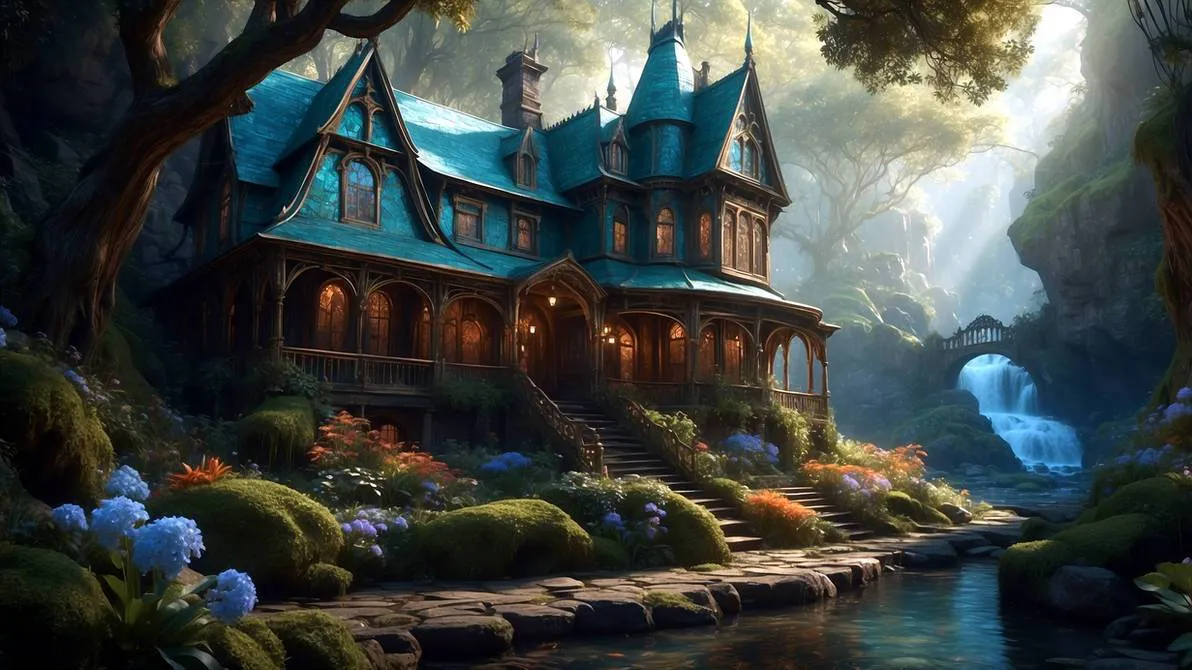
「Pre-Hogwarts Education for Wizarding Kids」
──────────────「WIZARDING EDUCATION」───────────
Education is the key to turning a child with magical potential into an adult capable of controlling and rightly using their magic in society. As Headmaster Lear is fond of saying: "First and foremost, the expectation is that students get some sort of pre Hogwarts education. Muggleborn students have the conventional means of learning offered by muggle schools. It only makes sense to me that the same opportunity is offered within the wizarding community." Whether the witch or wizard in question was initially educated in the home by knowledgeable and astute family members, by private tutors or by school masters in a preparatory school setting, wizarding culture has always held education in very high regard. After all, Hogwarts School of Witchcraft and Wizardry itself was founded more than a thousand years ago for the express purpose of educating young magical folk!
School Masters and Tutors. Some might find it odd, but the truth is that many of the men and women who teach our young children their letters and numbers are in fact Squibs. This makes sense, as they are familiar with magic and with wizarding society, but since they are unable to work magic themselves, the opportunities they have in the wizarding world are often limited. Teaching affords them an honourable position.
Whether tutors or school masters are squibs or magical, they must be well versed in the topics they teach. Some may have even taken courses of study in the muggle world. Some may make use of these muggle teaching techniques, though many wizarding parents are understandably wary of such things!
Study Materials. Whether the class room is housed in a small preparatory school or is a study within one of the Pureblood families' mansions, a wide variety of materials and instruments can be found. Most common are, of course, books and parchment. Lessons must be read and studied; assignments must be written! Charmed books that read themselves, magical chalk and quills that guide a young student's hand as they navigate the wonderful twists and turns of the written language and enchanted toys are almost always found in any classroom setting.
Curriculum. Within the walls of a wizarding school, kids study four basic subjects:
First is literacy. Children often come into school already knowing their letters and how to read a bit, but not everyone does. They practise forming letters, writing words, reading and grammar. In this class, a child studies mostly English, but will also likely meet some basic Latin & Greek, as well as their regional language. Special attention is paid to quill sharpening and not blobbing your ink on your parchment!
Second is numeracy. In this class, children learn the basics of numbers, counting, arithmetic and mathematics. Children learn how to use various mathematical devices, such as the abacus, the addometer and the slide rule.
Third is natural history. In this class, students are introduced to the basic sciences: plant and animal life both magical and mundane, geography, physics and the like.
Fourth is social history. In this class, students learn about local wizarding culture & traditions; history; civics; art and mythology.
bbbbbb
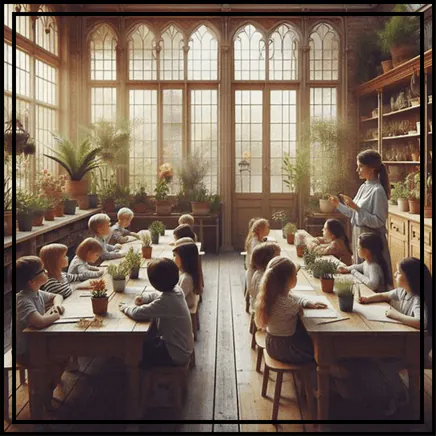 |
Not all instruction is given in the classroom! These topics are often combined with a strong hands-on component. Schools often have a garden where children learn to care for plants and animals and school masters will often take the children out into the local woods or countryside to hold class outdoors. Children also have exposure to skills like cooking, crafting & farming and arts like music & singing. They'll learn how to use an abacus and a set of Napiers bones for calculating; they'll learn how to do cursive writing and printing;
|
they'll learn how to dig & water in the garden; how to weigh and measure using scales and measuring spoons; they'll learn various herbs and trees and other things of nature by getting out into the countryside and getting their little hands on bugs and rocks and perhaps even see some magical creatures!
There is also plenty of time for breaks and play! Occasionally schools will have toy brooms so that games like quidditch or even swimming will be played, but kids are mostly allowed to play whatever they please outside!
Part of learning is testing the students. Whether the exams are oral or written, they are intended to ensure that each child destined for Hogwarts School of Witchcraft and Wizardry is well prepared for their future academic courses. Each course of study is accompanied by an examination which will determine the student's grade for that course. When the courses are passed according to Ministry guidelines, a diploma is awarded and the wizarding student is passed along to Hogwarts.
The Parents' Choice. It is the parents' responsibility to ensure that their children are educated and that they are enrolled in some form of formalised schooling. So important is this concept that wizarding parents who fail to educate their children can face legal penalties. Given that wizarding preparatory schools are privately organised, it is also the parents' responsibility to determine whether their child would be accepted at the school or by the tutor. Some schools prefer to cater to certain groups, such as part-goblins or the children of werewolves. Other schools will take on children of any background.
Which method to choose when it comes to a family's education is a difficult question, including considerations of family pride, economic means, location, reputation of the school, etc. There are many resources available from local communities, other wizarding families and by owling the Ministry for suggestions. Schools often accept students on scholarship or need based grants if families can't afford.
Some, especially Pureblood families, might be hesitant to place their children in a preparatory school. While known to have existed for a long time, they have often resided in the background, only coming into their own relatively recently. The ancient traditions of homeschooling and tutoring are still very strong, even in areas where small schools are available to these families.
Parents also often differ in when they send their children to school or start home schooling. Some will start formal education as young as 3, which is considered quite young or as late as 7. This formal education can range from tutors to more formal academic settings.
Regardless of which path parents choose for their families, each child is expected to obtain some form of formal education. This said, the Ministry expects only that magical children be able to read, write and cipher to the prescribed standard. It is for this reason that schools exist and that tutors and school masters alike must administer examinations to their pupils.
─
「COMMUNITY SCHOOLS」───────────────────────────
There are many community preparatory schools, scattered around Magical Britain, and perhaps you went to one of them! Let's take a look at one of them. Tucked away along a narrow lane in a lovely Somerset village there stands a modest brick and dressed stone building. The stone wall that surrounds its garden is high enough to keep any stray Muggles at bay, whilst its gate allows access for those allowed to enter the premises. The structure itself is grand, though not overly imposing in size or architectural wonder. |
L |
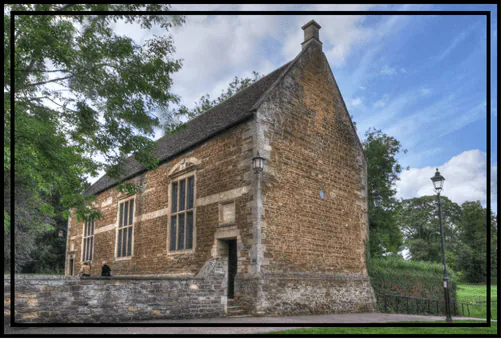 |
A heavy wooden door at either end, set into the wall, forming tiny alcoves that allow the entrant to shake off her umbrella or remove his cloak, opens into an entrance hall. This is one of Britain's many small, privately operated wizarding prep schools! Unlike Hogwarts, students don't study magic itself here; though they do learn about the wizarding world they inhabit.
Here in the entrance hall, students hang up their cloaks, greet one another, finish up any games or gossip they were engaged in before entering the school house and get themselves ready for their morning of lessons.
Tall wooden doors separate the entrance hall from the high ceilinged school room beyond. And once inside, students are greeted by a spacious room furnished with a variety of tables, chairs, desks, shelves full of books and materials. Three tall windows give a view of the garden and trees outside, or else the sky above, while the other wall is dominated by a huge blackboard.
LLLLLL
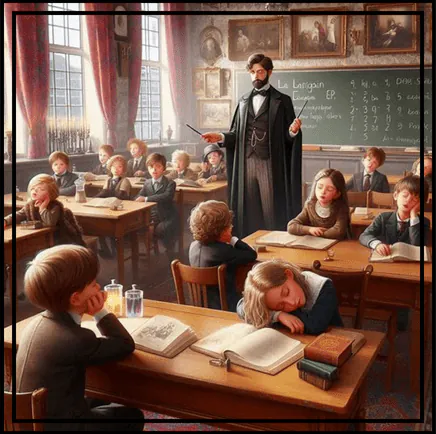 |
These children are not surprised at how the blackboard rises up or sinks back down into the wall as the school master’s chalk flies over the smooth slate slabs. Especially given that the school master himself is walking between the tables around which children of various ages, though all younger than eleven, are seated. For these are wizarding children, mostly Wizardborns and Purebloods. Though there are undoubtedly some Halfbloods and perhaps some of the children themselves are Squibs. |
Only time will tell! Most of them have already shown their magic, and the wizarding school master must be ever vigilant for the accidental setting on fire of some poor student’s scholars robes! In some of these prep schools, you might even find some dhampir or part goblin kids. Many of these schools welcome any magical child, some remain more exclusive.
LLLLLL
Some magical children begin their ordinary education, not at eleven when they start Hogwarts for their magical studies, but rather younger if they are home schooled, tutored or if they attend one of the numerous small, privately operated, preparatory schools that dot the United Kingdom and Ireland. Some of these schools are quite small indeed, and the school master might only have twelve students! In magical London, for example, there are several larger schools with a larger number of students.
|
L |
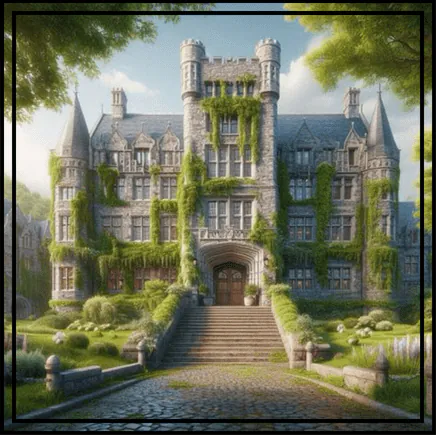 |
This little school in Somerset is but one of many small prep-schools that wizarding kids attend all over Magical Britain. Whether your school was but a single large classroom with one school master and all the children were in one class regardless of age, or whether your school was divided into different classes by age, your years of pre-magical education was largely the same as anyone else’s.
───────────────────────────「TUTORS」─
Not all wizarding children live in villages or towns though. And some inhabit social classes that value a more individualised education over a classroom setting. Children of very highly placed Pureblood families, for example, are often educated at home by private tutors.
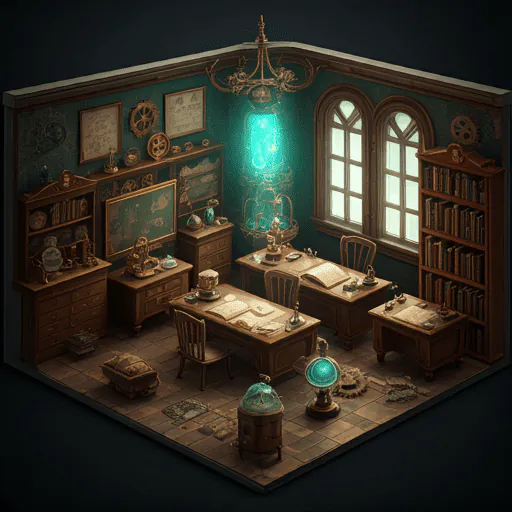
A tutor is a wizard who is well versed in a wide variety of topics who takes on the job of educating the children of only one or two families at a time. A flying tutor might teach at one mansion in the morning and another house in the afternoon and a third one in the evening. A residential tutor lives with a family as part of the household and caters only to that family’s children.
bbbbbb
The course work for tutored children is much the same as that for children who attend a preparatory school: they learn to read and write, to count and sum, they learn history and geography and all of the other topics wizarding kids learn. The only difference is that a private tutor tailors the education of the child to a much more individual level and they often teach their topics much more in depth. In addition to a regular tutor, some families will also bring in specialist tutors to teach particular topics like sciences, music, dance, astrology, Latin & Greek, and social etiquette.
bbbb
bbbb |
L |
bbbb
bbbb
bbbb |
─
「HOMESCHOOL」───────────────────────────
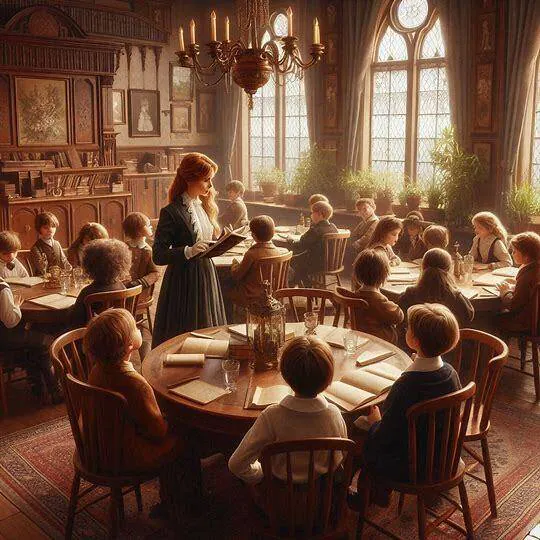
Lastly, a third option that some families choose is to homeschool their children. This of course means that it is the parents who take on the role of tutor or teacher. As with hiring a private tutor, the teacher-parent would offer instruction on all the basic topics recommended by the Ministry to comprise a suitable and adequate education for young magical children. Since parents are rarely fully qualified to take the place as a proper teacher, the Ministry offer a number of books and supplies to help guide parents who wish to take this route.
 |
L |
Often times, especially in areas where several wizarding families live near another and a preparatory school is not established, parents will join together in what is known as a co-operative or "co-op". If one parent is well versed in mathematics she might be asked to teach the children of several families that topic, while another parent who is more disposed towards language and grammar might be asked to teach that subject. |