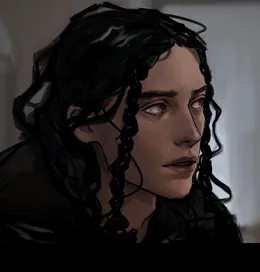
Borderland

Naturally being the best dressed sonuvabitch in the room, Archer was in vehement belief that his duty extended beyond that which of wall-flowering away another party.
Conformity was as much a bosom friend as his failed endeavours with distant memories, and true to his nature, Mister Duncan arrived dressed in contemporary garb, a far cry from the nineteenth century styles of his peers. From the pressed shirts and tailored suits of his childhood, to his present carelessness for appearances, fashion statements once approved of were discarded, and lives once as freshly ironed as the garments of his past were scattered to the winds. Like the ashes of his mother, that cursive line in her will asking to never be confined to the ground.
A pair of lost hands searched for pockets, ten knuckles clasped upon delicate fabric.
Introspective hazel eyes surveyed the crowd, desperate to latch onto any familiar face. The comforts of acquaintance he had arrived with had lost themselves amongst the throngs of attendees, colours an array of the rainbow, shapes a spectacle of geometry. Each in a brightly-coloured costume of festive classic children’s literature, only he was the sore thumb as the group’s dark and dusty outsider. His clothes held no elegance, nothing of the pampered blazers and indulging gowns of his schoolmates. He was Alice, fallen through the rabbit hole and into an unknown land, except there was nothing wondrous about his predicament, and nothing curious about his situation.
In fact, his curiosity was dimming with every step he took into the Courtyard.
His eyes brushed over the assemblage of foods, beverages, and other assorted miscellaneous adornments, none of which catching his appetite nor attention. He manoeuvred through each stranger like a ghost, occasionally slipping too close to someone, occasionally brushing upon their shoulder, yet dismissed with an insignificance anyone else would have taken as offensive. For Archer, however, it was the perfect amount of carelessness. A new moon in the night, dark, invisible, yet forever present, still holding the reins of the tides, still influencing the dispositions of man — he would rather be hidden than seen, rather stand in the corner than face the audience. He was content, satisfied, and more so enchanted to live a life tucked away from this cruel life. The knowledge he was a ghost was not daunting, it was a quiet reassurance.
Sliding between worlds, bumping into backs, eventually Archer meandered to a much quieter section of the Great Hall, where the candles dipped low and the music faded into the distance, becoming a mere backdrop rather than a tedious distraction. Mechanically, in an action done countless times prior, he retrieved his commonplace book and pen no different from how an addict would retrieve a lighter or an alcoholic his bottle. His ballpoint clutched in his hand as if the grooves and curves were made for his palm, as if it ought to have been attached to him as a second finger.
With a flourish of his pen and the ragged edges of his handwriting, letters were produced, then words, then sentences — blunt descriptions of his sentiments, brusque notes of his senses, before he went onto florid metaphors and elaborate descriptions, mind a whirlwind as the dancers twirled before his eyes, a mess of dresses he could not comprehend, promises too overwhelming for him to contain. He decoded life from an enigma he could not make out, he translated the world from a language he could not understand to one he could, and finally, he was starting to make sense of it, if only barely.
He was almost there, a step away from the abyss, yet with one foot on the cliff. Now, reentering society, he was plunged back into an ocean not knowing how to swim. Now, reentering a life he had once forsook, he was holding onto the barest of ledges, praying to the most irrelevant of gods. He was one slip away from demise, he was one wrong choice away from a tumble. Icarus, reaching for the sun, swooping into the sea — and he, just a lost boy, pretending he could fly. If he fell now, where would he land?
This was Wonderland — some imagination was due.
@Roland Domagoj Marin | banner by Adeline Spinks
I am not even singed. My wings are untouched. You use them for everything, except flight.
Liliya Starkova| Anthonie Engelbrecht
Liliya Starkova| Anthonie Engelbrecht

Borderland

| —— |
—date. [ 17/04/26 ]——————word count. [ 1234 ]— —interacting with @archer duncan— Roland, the sole heir to parents who owed their habitual coughing equally to burning tobacco and the ancient dust of the stage, belonged to a rapidly fading breed and lineage. He was easily be regarded as an anomaly, a vivid organism infected with a terminal yearning to inhabit a world where the rainbow violently fractured through a crystal prism and washed the dreary earth with its magnificent colours. Alas, he was one of the few remaining, primarily because his peers' brains were about to liquefy and leak out of their ears whilst playing Roblox on their ghastly little tablets (or casting unnecessary and useless spells with their joystick-y wands). As he gracefully played with the ideas and words, and as he gleefully bastardised every grave matter into fodder for the cheekiest humour, Roland liked to believe he was staging a grand resistance. A one-man resistance against the always unkind, frequently grotesque, and rarely charming realities of existence, against the green, absinthe-bitter posturing of the romance gone wrong, against the artificial pallor of the superficial melancholy, against the careerist and network-ist banalities championed by the tamed middle-class beelzebubs, against the hyper-elevated, 'I-transcended-the-flesh' glare of ascetic monks who were simply terrified of their own shrivelled meat and marketed their own cowardice before the astonishing presence of the life as high-tier meditative virtue. And finally, against the greyscale flattening of existence, that soul-crushing black-and-white filter where all the glamour, flair, and magic was drained away and the human spirit was sealed in a tin. He was a Wildean child of his age, our boy Roland. Bestow upon him his luxuries, and he could survive without the base necessities. He was the sort of boy who, even the Almighty, with His ancient tendency to wage an unjustified war and to reduce the world to ash via meteors, lightning, or some other sickeningly violent protocol He fancied, would still consider maintaining a witty smirk born of a clever pun to be vastly more vital than initiating a rescue op for an endangered species. A soul that a parish vicar might want to cleanse by having it dry-cleaned, or that a businessman with a neck twice as fat might want to fumigate in the soot of Reading Gaol. But well, it was no secret to Roland that djeca, budale i pijani pravdu govore. (hr. Children, fools & drunkards speak the truth.) Having concluded his little spectacle in the Courtyard -the underlying motivations for it remained heavily encrypted- he slipped back among the bodies of the others. He had mercifully avoided displaying his rather atrocious dancing skills, and mercifully in an equal amount, he had refused to tumble about like a maltreated circus elephant. Instead, he had bypassed the baseline glamour of the broomstick entirely, and simply levitated his tiny body with the obnoxiously short and inoffensively swanky wand that Ollivander had foisted upon him under the pretence that it was the one chose Roland. As the red cashmere scrap, tied about his neck in the rough approximation of a proper cravat, swung at his throat, a sudden realisation settled over him: How shockingly few people he actually knew in this castle. But then, Roland had always operated within a restricted, high-loyalty cellular structure. There was -agonisingly, still- nothing new under the sun. To stir the elusive willpower required to prolong an acquaintance, a highly improbable alignment of the stars somehow necessary. If a spirit carried no sharp pull of the eccentric, that deficit could only be compensated by two high-value assets: an unassailably brilliant gift for the spoken word, or a face so dauntingly beautiful it made one want to cry. If a target failed all three checks, Roland felt the weight of a new acquaintance as a grey toil, akin to the writing of a History of Magic essay, and he would simply place the stranger in question on a dusty shelf of his memory-land, those gallery of portraits one politely nods at and never wishes to greet again. It might sound rather arrogant to an untrained ear, but honestly, if one must squander the precious gift of time -in a life just slightly more interactive medium than a stack of bound paper- ought not the companion be at least mildly diverting as a Coward play? And so Roland drifted onward across the Courtyard, his limbs somehow locked in a silent procession, his voice bleedingly silent, as though he were still an artefact laid bare before the crowd. He had a sneaking suspicion that he was, in fact, the most unbending thing among them. His blue eyes scanned the heavy walls of the Courtyard with its sweeping eaves, long and low, looking as though they had vomited themselves out of the earth like some swollen moon, covered in creeping vines. Beneath the heavy scent of blossoms, his mind staged a strategic retreat. He needed to delta-out this temporal zone, away from the perfumes of the season, and its tedious associations with crucifixion. But the sheer hereness of the spring dusk held him hostage, and Roland executed a stiff manoeuvre toward the lower-decibel zones of the quieter corners. And there was a boy. There is always a boy. The castle was a ceaseless web of crossings, a multi-year carnival of forced or voluntary interactions where many a good soul was tragically lost. Roland positioned his dorsal plane against the stone surface of this rather isolated sector, observing the boy with sneaky glances. The body before him was neither bound in the ribbed agony of a ballet corset nor caressed by the Liberace-esque splendour of stage dress. This calculated lack of effort felt rather familiar; it was the uniform of the quiet radicals who occasionally gathered on the balcony of their home back in Dover - the uniform of the pretension of being entirely unpretentious. But then again, who knows? Perhaps the lad was just a slob. Judging by his years, he was older than the young lion. Thus, if it was the case, it was a deliberate carelessness designed solely to avoid drawing the attention of the hungry eyes, including the amorous ones. Roland would've gladly doffed his hat to that level of apathy, had he possessed one. In this jungle of hyper-emotional juveniles, a mob absolutely desperate to sob their eyes out on a therapist's ottoman, romantic celibacy was as rare as the swansong of an endangered bird. Under such circumstances, the muses of the Gryffindor would inspire not a melody, but a barbed remark to hurl at the boy. The revelation was buffering. Roland spoke, the sound slipping from his thin lips like a quiet whistling. "Ah," he said, "another soul who forces himself to attend a party, just to actively ignore it." Lifting his gaze from the stone floor to study the boy, he effortlessly quoted the Bard: "The apparel oft proclaims the man." He executed a physical override on the red pseudo-cravat over his shoulder to stop its maddening swing. "Please, do forgive the display," he murmured, the shadow of a smile gently touching his mouth. "I foolishly threw myself into a pointless bid to be elected Spring Ball King." A micro expression, bordering on a smirk, manipulated his mouth. "A kingdom won by the counting of common votes... well such a contradiction brings no grace to anyone, I fear." He then seemed to address the empty air; a private thought escaped the borders of his mind. "I must grow my hair out soon." ═════════════════════  ═════════════════════ ═════════════════════( codes & banner by harlan ! )— | —— |
| sta • 6 | eva • 5 | str • 2 THEATRE KID wis • 9 | arc • 7 | acc • 6 | the muggle condition THROUGH⠀THE⠀YEARS every step a scene worth watching |
Borderland
Roland Domagoj Marin was aptly described as cocksure, brash, and inconsiderate, with just an edge of academic charm Archer could not quire resist. Any other boy with his temperament had no excuse for their actions, yet this subject, brimming with aplomb even in the face of his darkness, harboured a sharpness many failed to possess. Undeterred by his presence, the youth seemed almost drawn to his existence, sneaking keen looks at him from the side of his eye, glances Archer pretended to ignore. His eyes fluttered to a close, yet he did not wander towards the drinks table, or plunge himself into the chaotic whirlwind of the dance. Waiting in apprehension to see if interest would brim over the barriers of uncertainty, and hoping on every god that it would not. Waiting.
A horrendous almost-whistle led Archer trudging out of his imagination, and smothered him in the ache of reality. He remained perfectly still, refusing to answer to such base ways of address, assuming the noise was for a stray puppy rather than himself. Behind closed lids he rolled his eyes, finding such a bare sound already a display of inexcusable patronisation. He rested one foot on the wall, boot scraping against the column of the courtyard.
“Ah…”
He hoped that was all, the minimal acknowledgment, only to be badgered by further comment.
“Another soul who forces himself to attend a party, just to actively ignore it.” The remark was painfully unoriginal, expected after three years’ engagement in events that meant nothing to him. A snide reply had already slithered to the front lines of his mind, readying a cavalry attack of detergence, yet he deigned not to lower himself to such levels of the stranger. It was beyond inferior to engage in an argumentative nature with a bare child. Instead, his head tilted slightly, as if caught in thought, and a smile slipped onto the form of his lips, and whether that was the wolf bearing his teeth or a gentleman’s invitation was entirely the pre-teen’s choice. Their eyes meeting as his lifted from the distraction of the cobbstoned floor, Archer, despite becoming the target of scrutiny, found himself laughing, sound crisp and unintimidated. Really? he asked, with solely his gaze.
Filtering through endless comments, it was the plainest that built enough strength of enunciation, and Archer spoke with dismissive condescension,“And who are you, exactly?”
Despite the question being largely rhetorical, he could not fully exile the curiosity slipping into the edge of his words, and as sincerity overtook sarcasm, an answer from the ostentatious boy was expected, without the flourishes of theatrical distractions. If he would be granted the favour, Archer would return it with the sole privilege of his name, first, middle, and last, uttered in a wearisome drawl of a voice. If not, then the unnamed nuisance would remain as insignificant as he was when they had first met, mere moments ago.
Then a line was spoken, and recognition struck. Recognition, not only of his reference, but of the possibility of potential kindred spirit. In a world operating on the superficial natures of materialism and shallowness, the rare gift of connection was one he cradled. The quote was the warmth of an outstretched hand of a home he knew amidst a land where he was a foreigner, something to latch onto when the music spun him in circles far too quickly for his control. A small gasp escaped him, and a genuine smile touched his face as his lips widened at the two syllables of the name he savoured: “Hamlet?”
Whether he would receive an answer or not, however, the mouth of the oddity of a boy was not done spewing forth dynamic words: “I foolishly threw myself into a pointless bid to be elected Spring Ball King.”
“What?” He exclaimed, almost with excitement at the other’s inane nature, another laugh escaping him, this one of true amusement. “How fatuous of you! I was almost convinced to join, but I hope you know I have more dignity than that.”
“A kingdom won by the counting of common votes…” His voice soon trailed off, and not long after, Archer stopped listening altogether. When his flamboyant words finally drew to a stop, he realised it was his turn to participate in the conversation, and clumsily shrugged his shoulders.
“Frankly, I have no idea what you’re talking about. As you can see, I’m not much for watching such things,” his words slipped out with the utmost ennui. He had slid into a random seat in the audience of the pageant for a few moments, before being absolutely bored to death by the first performance of a ballet sequence, designed for attention spans far too saintly for his generation. His exit had been swift, yet quiet, and he rolled his eyes at the concept of a talent show of people begging for attention. “I’m just glad you’re not trying to bribe a vote out of me, that already happened once today.”
“I must grow my hair out soon.”
The sudden words struck him with an ounce of surprise and two of perplexity. Archer regarded the arbitrarily-spirited youngster with a glare, not of vexation but pure bewilderment. He had little idea what the boy’s hairstyle choices had to do with himself, yet as he followed the deep wells of enigmatic blue that traced over each strands of his own locks, he decided to apply his elder age and greater experience to his advantage. Flipping his hair Archer shook his head as the waves unravelled from their usual tousled mess. Self-consciously he ran a hand through the knots, for whereas his peers had spent the afternoon styling themselves, he would never be one for the sham of parties, the carnival of oddities pretending as if they belonged somewhere. “It’s quite nice,” he decided. “High maintenance though. And I got mistaken for a girl once… but your features aren’t quite androgynous enough for that.”
Hair held memories. And whenever those memories were too much to handle, he cut.
Archer pursed his lips. “Let’s play a game, shall we? I’ll bet you ten sickles you can’t make me enjoy the night.”
@Roland Domagoj Marin | banner by Adeline Spinks
I am not even singed. My wings are untouched. You use them for everything, except flight.
Liliya Starkova| Anthonie Engelbrecht
Liliya Starkova| Anthonie Engelbrecht
Borderland
| —— |
—date. [ 17/04/26 ]——————word count. [ 1277 ]— —interacting with @archer duncan— There are those moments when a man, having smiled delightfully whilst conversing with his beloved ones, finds himself alone in a courtyard, and his face suddenly falls into shadow as though a most devastating earthquake had just swept across the geography of his face, leaving nothing but the flattened rubble and scraped indentations of ruin. It is the prickling anxiety of one wearing a snow-white, newly starched shirt and attempting to eat a ripe pomegranate. And this was what Roland was not. In his glamorously uncorroded heart, he was at peace with the rather melancholy fact that ships, resting side-by-side, must eventually fill their sails with the wind and drift away across the blue-black waters of the world, never to meet again. Angst - his mother's friend used to call it, who was an eternal fräulein, a battle-scarred émigré from Travemünde, an unwilling survivor of a shipwrecked life, and a writer who had penned two unpublished plays she firmly believed to be masterpieces. And that feeling was the sole pivot point of a realm to which this Croatian-French mongrel of a boy, who was nonetheless hopelessly British in all his peculiarities, was still a stranger. Alas, only for a very short time. Our boy, too, would eventually have to make its acquaintance. Life never allows for any other possibility. He'd live in houses that'd never be truly clean, no matter how much they were cleaned. He would bind himself in relationships over which no heavenly choir would ever sing a blessing. He knew it not yet, but he was going to start smoking - puffing away on his balcony, utterly lost in the question of what to make of his days. He would learn that even gallons of Pepperup Potion could do nothing but shrug in absolute despair against tumours that will invade his lungs, just like a desperate youngster realising that signing every campaign on Change cannot actually alter the brutal course of the world. But all this lay far ahead, the ladies & gentlemen in the vestibule, and the scene was going forward. With all its glory, and all its glorious lack thereof. The words pouring from his lips seemed to slip past the lad, resembling nothing so much as a volley of poorly aimed owls, sinking uselessly into the empty plain. Roland thought to himself that perhaps this was just another Cirrus. The rather jejune realities of school life had forced him to broker a bloodless truce with a most disagreeable truth: some people actually enjoy the harshness of directness. It seemed that the most handsome, enigmatic uncle in the great family of words, i.e., those deliciously indirect phrases often meaning nothing serious, was simply failing to seduce certain hearts. If Roland were firmly convinced that the lad facing him was of such a hopelessly literal silk, he would've felt the bitter weight of regret for having tossed a syllable in his direction. Yet a prickling thorn of doubt, a silent 'what if?', stopped him from feeling that. For it was a certain truth that the sole unforgivable sin of a drawing-room society was the vulgarity of trying too hard, and this boy, standing at the very dawn of his adolescence, seemed to tread the delicate borders of an elegance that stemmed from nothing but a total nonchalance. Assuming Roland's heart had not completely misled, he was still well worth the gamble of a conversation. Suddenly faced with a rather existential question hurled his way -'And who are you, exactly'- Roland might gladly have seized the opportunity to chatter away till doomsday. But his desire to introduce himself to the older boy ended up overpowering his usual lust for idle chatter. "Roland Domagoj Marin," he answered, taking a clear pleasure in pronouncing his name out loud. "Way too tired to be at your service." This little rearticulation, spilling from his lips simply because his wit refused to be bridled, served only to remind him how tired he actually was. It had always been this way for the young lion, life trotting at the heels of the vocabulary. He shrugged, muttered a dismissive "Meh, who cares?", and dropped himself upon the floor, crossing his legs against the stone. He was, quite unfortunately, aware that his cream-coloured trousers were destined to be stained, but he carried another knowledge to balance it: how to cast the Scouring Charm. He tilted his head slightly toward the boy and asked, "And you? Maybe Otomar? You strike me as somebody from Prague." Roland enjoyed his entirely groundless little fantasy that his interlocutor might be actually a native of Prague. Heavens knew, he had seen very few things from Prague in his life that were not locked away inside a museum, and there was a most lamentable famine of Prague-ites wandering the globe. A little voice within him, however, quickly echoed the pessimistic certainty that this night would bring no change to the drought. But then, when the boy recognised the line Roland had mumbled in passing, out of his compulsion to constantly quote things, his expression utterly transformed. He felt a deep gratitude towards the above-mentioned sharp thorn of doubt. Yes, this was someone actually worth talking to. For Roland believed that wielding the deity-like power to warp the very fabric of reality with a simple flick of a wand, yet walk the earth in total blindness to the iambic pentameter was the most hideously ultimate, and ultimately hideous triumph of vulgar utility over beauty. And it was clear that the older boy was not one of those hollow, pointed-hatted philistines. And unlike Newton's, there was an incontrovertible law of nature: anyone who can recognise such a casual quote from Hamlet so readily deserves a kiss on the forehead. (Of course, Roland isn’t about to do that - you dodged the bullet, Archer). Roland couldn't hold back a smile at the other boy's reaction to his candidacy - partly out of a smug satisfaction that the other boy was finally falling into step beside him, and partly from the thrill of hearing the word 'fatuous' used in a sentence. Resting his head sideways upon his knees, "Well, I'm not likely to be elected," he remarked, "I'm not the Ghost but the Fool, you see." In the whole sprawling catalogue of Shakespeare's works, indeed, the figures with whom he felt a genuine kinship were those motley crowd of fools. The Sexton came to his mind, and of course, his song. Easy to memorise thanks to its bouncing rhymes. With a half-smile caught on his lips, he recited the words: "A pickax and a spade, a spade, / For and a shrouding sheet, / Oh, a pit of clay for to be made / For such a guest is meet." Lifting his golden head from its temporary perch, Roland found the solid support of the wall behind him. Having untangled his knees, the young lion stretched them out before him, swinging his feet toward each other. He felt a tad affronted by the loud and clear statement that he was not androgynous enough. He was not, after all, just some aggressively masculine boy who moved with the stiff awkwardness of a plastic Lego figure! "Ten sickles?" Roland exclaimed softly. "Are you that broke?" He smiled, half-chuckle & half-snort. "Something is indeed rotten in the castle of Hogwarts." Then, he lifted his blue eyes, holding the boy's gaze from below. "I accept the challenge! But to make you enjoy the night... how about... fetch me a drink, perhaps? The place is swarming with prefects. Ergh. They see the turning of my eye when I look at anything other than the pumpkin juice. Creepy." ═════════════════════ ═════════════════════( codes & banner by harlan ! )— | —— |
| sta • 6 | eva • 5 | str • 2 THEATRE KID wis • 9 | arc • 7 | acc • 6 | the muggle condition THROUGH⠀THE⠀YEARS every step a scene worth watching |
Borderland
O Affectation, blessed friend of the teenage bohemian:
let you disorient, let you guide —
only let you not falter at the pretentious son’s side.
The teenage bohemian was feeling more akin to a teenage flop, but at least he could act with dignity.
When Roland expressed his exhaustion with unbearable wittiness, Archer merely raised a brow, and tutted in distaste. “Well, you’re at my service anyways.” The reckless hero who chose to throw himself into the depths of Tartarus did not deserve to walk out of it without tasting the wrath of the Furies.
In response, he was faced with a sentence deliciously careless, and a boy who slid down onto the filth of the ground, while still managing to maintain such impeccable aesthetic. “Meh, who cares?”
“Archer Theodore Duncan.” He found little flourish to add to the dull predicament of trivial introduction, and even less as his own name came out in more of a mutter than he had hoped. Yet he stood straighter, or as straight as he could manage while he used the nook of the wall as a crutch. Against all expectations, Archer hoped, with all the depth of his shallow heart, that he cared. He cared for the boy who could quote Hamlet’s stray gravedigger off the top of his head, he cared for the boy who saw the world in metaphors and florid pen strokes, he cared for the boy who treated life as if it were merely theatrics. The reason, simple yet pathetic, was because he, in his Wildean glory, represented everything Archer could never amount to be in his Kafkaesque existence.
When the subject inevitably turned to matters of the play on the royal court and lightness forced upon him, “I shall vote for you anyways!” Archer ejaculated with immediate enthusiasm. The bid for Spring King, such a jejune display of callowness, being a complete and utter fool’s errand, was only fitting for the boy who had just deemed himself as one half a sentence ago. While Roland dismissed himself as too much of an ignoramus to receive the position, surely a kingdom of idiots could only produce a king that followed in disposition. And so he added slyly as his eyes landed on the other’s — “Just to spite you.”
All in good faith, though. Roland’s next words, however, proved that he was not the only one withstanding the fires of spite tonight: “Are you that broke?”
Archer gasped in faux dismay, cocktailed with just enough malice for the sarcasm to dwindle between sincerity and irony. “Stop it, Roland, a gentleman never exposes the financial status of another.” His tone measured, with a smoothness perfectly contrasting what he could only describe as Roland’s barely contained chortle, not for one moment would anyone assume that his family teetered on the edge of economic ruin. Therefore, allowing his delusion to lose himself in the mocking humour, he did not mention that he was, in fact, that broke, as Roland readily accepted his challenge, for the unseemly price of ten silver coins.
Although, if another task were preferred, a recitation of Gerard Nolst Trenité’s The Chaos was always a welcome sight. Anyone who managed to slog through the horrors of the English language deserved far more than what meagre savings Archer had to offer. In fact, they deserved a compensation to their sanity.
—
“Fetch me a drink, perhaps?” Their eyes met in perfect synchronisation.
“Please, I am not your dog,” he protested, although a smile graced the crevice between his lips. Young Roland Marin wrecked his pessimism with the ferocity of an earthquake, and the moving of his features’ tectonic plates demanded the canyon become upturned mountains.
When Roland showed no signs of relent, “Ridiculous,” he proclaimed, loud enough for the gossiping couple to their left to hear. “Which prefect, exactly? I’m friends with half of them.” He raised the tip of his chin, in challenge that was undoubtedly boyish, and undoubtedly himself. Then his eyes followed the boy’s, and they landed on a figure all too familiar, carrying history he would rather not disturb with such trivialities. His eyes lifted towards the star-sprinkled night sky, as if lamenting towards the heavens, why, of all days, must they choose today to be on duty. With a begrudging grunt, he lifted himself from the comfort of the wall, the corner that hugged his anxious body with a universe of solace in a mere microsecond. So as he was plunged into the world of music and dance, a darker shadow crossed over his features. Perhaps it was merely the result of the wind, blowing long, unruly hair into his cheeks.
He turned towards the boy with a soldier’s precision, then raised a sophomoric finger in the air, before bowing with overblown sarcasm. “Ah, only this once, dear Roland.”
Servitude, as it would prove, was not a suitable pastime for Archer’s particular pretension, so when the boy of fourteen, rebellious, even to the most innocent of souls, swiped two drinks off the table, the genuine consideration of blessing Roland with the taste of his saliva crept into a mind otherwise formed by ostentation and the occasional exposure to etiquette. Yet as he gave the glasses a twirl, promenading through the short walk back as if he were some boy king on display, the distant figure of Roland, vulnerable and entirely subject to his whims, gave him pause to think for the boy falling into sapioplatonic infatuation over one recognised Hamlet quote. A small smile played on his lips, and as he stepped up in front of Roland’s sat position, did not purposefully hide the crease in his expression.
Archer took a sampling sip from both glasses, holding them up to his lips one by one. First tasting the lime-infused drink, he allowed the flavour to linger, just under his tongue, for fleeting seconds, before swallowing, its sparkling nature dancing down his throat. Its counterpart, however, almost deserved the hand raised swiftly to his mouth in a disparaging attempt to hide his own clumsy abhorrence. A scowl crossed his face, on unapologetic display as he met Roland’s eyes. Managing to swallow, a few curt words slipped out of his mouth, and miraculously, they were more than just uncouth expletives. “Bland. It’s a mocktail, as can be expected.” He held the former drink out for the youth, and with lips that slipped upwards into a smirk, spoke, “Here, I’m pretty sure this mojito got the better end of the deal than the martini.”
Was he a sinner to admit he enjoyed playing the martyr?
He leaned against the wall with frightening indifference, casting a cursory glance at the Roland sat below in the form of childlike crossleggedness. His eyes barely flitted, lashes dangling at the end of that glare, the one that held more than a shred of amusement, if not affection. He took a sip of the aqueous martini, cringed at the bitter taste of olive, then pretended to hide his own dissatisfaction with his self-sacrifice of beverages in a pensive gaze towards the distance, where figures, specks of colour across an artists’ ruined canvas, spun and twirled in dance, just a step out of reach. The music never stopped, and in the brief few moments he stared into their ensemble, he found his eyes crossing. Forsaking the grandiosity of the waltz for simpler delights, he mused in question, “Enlighten me, how does the intellectual aristocracy of your calibre entertain himself at such… dastardly gatherings?”
@Roland Domagoj Marin | banner by Adeline Spinks.
I am not even singed. My wings are untouched. You use them for everything, except flight.
Liliya Starkova| Anthonie Engelbrecht
Liliya Starkova| Anthonie Engelbrecht