The Archivist is a Muggle-born witch, formerly immersed in the non-magical world prior to her magical education. This dual exposure informs the structure and content of this archive.
—Archivist: O. Vanderbilt
Purpose Of This Collection
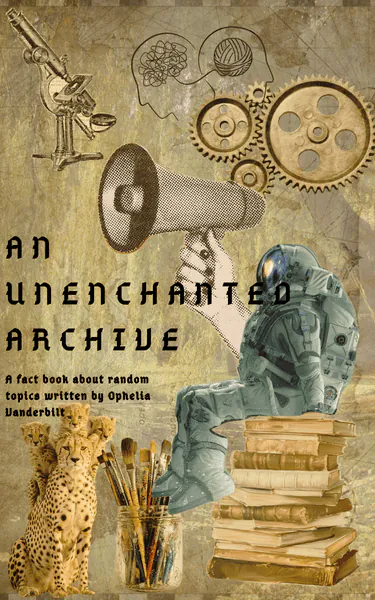
The purpose of An Unenchanted Archive is to inform all kinds of literate beings about different topics, mostly topics about the Muggle world, increasing their knowledge about them. Each chapter is about one specific topic, and includes a summary of what the matter is and how it works.
Each topic has its own unit, and each unit has its own color; in Archive Index, the topics may be shown in the color of their unit. In Inquiry Registry, each unit can be found, including the questions the archivist would ask themself before summarizing the facts. Beware that not all questions may be answered, but no more than the answers to those questions would be shared. Different sources may be used, which the reader may find at the very end of the topic. If your character is reading this book, please tag the archivist.
Inquiry Registry
Nature
1. How do they work?
4. Surprising Fact
2. Where to find them?
5. Historical Note
3. Why do they matter?
Science & Technology
1. Who discovered it?
4. How is it used now?
2. What problem was solved?
3. Explanation
History
1. When and where?
4. Long-term impact
2. Daily life
3. Key events
Countries & Culture
1. Overview
4. Language
2. Traditions
5. Festivals
3. Food
6. Cultural value
Politics & Society
1. Meaning
4. How it effects daily life
2. Why does it exist?
5. Ongoing debates
3. Historical key moments
Art
1. Where does it come from?
4. Why is it liked?
2. Artists
3. Style or techniques
Language & Literature
1. Origins
4. Works and Examples
2. Style
5. Where is it spoken?
3. Influence
6. How many people speak it?
Food
1. Origins
4. Facts
2. Ingredients
5. How do people enjoy it now?
3. Cultural meaning
Objects & Inventions
1. Who invented it?
4. Modern versions
2. What problem was solved?
3. How did it change lives?
Animals
1. Behaviour
4. Myths or symbolism
2. Communication
3. Role in ecosystems
Space & Universe
1. Basic science
4. Facts
2. Discovery history
3. Why is it fascinating?
Psychology & Human Behavior
1. Explanation
4. Examples
2. Why does it happen?
3. Experiments or research
Last edited by Ophelia Vanderbilt on 25 May 2026, 11:58, edited 4 times in total.
i knew who i was this morning, but i've changed a few times since then
The governor of a province of the ancient Median and Persian Achaemenid Empires in 550 BC, and also of the Sasanian Empire in 224-651 AD, and the Hellenistic Empires in 323-30 BC was called "satrap". The ruled territory of a satrap was called "satrapy".
Cyrus the Great established the system of satrapies in the Persian Empire. In his time, there were 20-26 satrapies, and later, Darius I refined and formalized the system with more definitive numbers, often cited as 20 or 30
A satrap was the direct representative of the monarch with considerable self-government. In Old Persian, the word "satrap" literally means "protector of the province". The word in modern Persian is "shahrban", which literally translates to "town keeper".
The modern usage of the word expresses a negative or disrespectful implication and refers to subordinates or local rulers.
Deoxyribonucleic acid (di.ɒk.sɪˌɹaɪ.bəʊ.njuːˈkleɪ.ɪk ˈæ.sɪd or Di-o-ksi-raibo-nukle-ic acid) is a substance that consists of very large molecules (polymer). It's composed of two polynucleotide chains that coil around each other to form a double helix. The polymer carries genetic instructions for the development, functioning, growth, and reproduction.
This structure was discovered by James Watson and Francis Crick in 1953; their breakthrough though relied on the X-ray diffraction work of Rosalind Franklin and Maurice Wilkins.
DNA is now used for forensic investigations, medical diagnosis, paternity or ancestry testing, improving crops, etc.
Plants also have a DNA, which is located in the cell's nucleus and within mitochondria and chloroplasts.
DNA can be destroyed or damaged by factors like high heat, UV light, radiation, and chemicals. It can also change through mutations from replication errors and through epigenetic modifications from environment or lifestyle.