III. Wizarding Solutions to the Problems
Classic Cars are Ace! It is a simple fact that the more modern a muggle car is, the more useless it becomes in the wizarding world. It strikes me that some muggles keep ancient and broken down motor cars as "garden art", forming a sort of centerpiece around which they might arrange shrubberies and flowers. If a wizarding citizen were to copy this trend, he would no doubt use the most modern motor car he could find!
It is also true that the older a muggle vehicle is, the more useful it is to a wizard and the more amenable it becomes to magical modification. In fact, it is often the case that very ancient motor cars need no magical modification at all! As we have seen, the refined electricity lies at the heart of the problem. Natural electricity, such as might be experienced during a lightning storm or the static charges one might zap another with on a cold dry day, having rubbed one's stockings along the rug, does not fail in the presence of magic. It is therefore likely that something occurs to electricity during the refining and distilling processes that make it useful for Muggles.
Our wizarding solutions to the problem of making use of muggle motor vehicles is therefore to replace all of the
electrical systems with improved
magical systems. Some of these systems are very simple to replace and any wizard could go down to the shops in London and purchase the required upgrades. A wizarding wireless replaces the muggle radio in a trice. Enchanted lanterns easily solve the problem of interior and exterior lighting.
The main problem with getting a muggle car to start and run is to replace all the electricity with magic. Several enterprising magical people have contrived a number of spells, transfigurations and devices to overcome this most devious of Muggle problems.
|

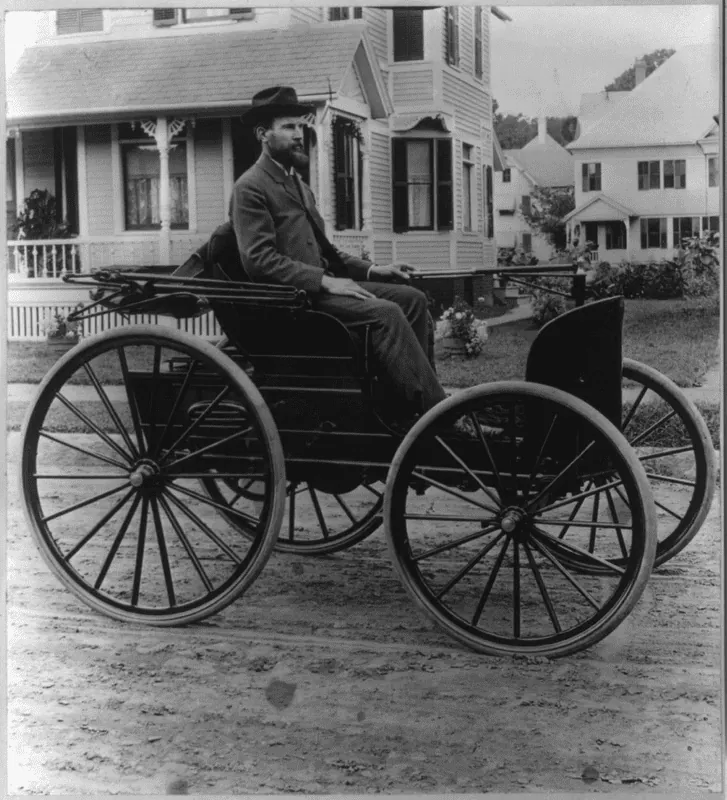
One early solution, proposed by Muggleborn wizard Malachy Kingsley of Oxford, some time around 1894, was to strap a number of baby dragons to the side of the motorcar's engine. Using a contraption made from brass gears, feathers and a clockwork phonograph motor, Kingsley was (barely) able to coax the dragonets into spitting fire by tickling them. Each time they spat fire into the piston chamber, they would ignite the petrol thus causing the motor to sputter and jerk along the country lanes of Oxfordshire. |
During this period of history, Muggles were still quite as baffled by motorcars as wizarding folk were. The Ministry had not taken any action as of yet, regarding the whole motorcar thing as a Muggle fad that would most likely blow up in Kingsley's face and make an end of itself. The sounds of exploding petrol, mixed with the mews and sparks of baby dragons, not to mention the erratic driving of the motorcar by Kingsley himself was the terror of the entire county until 1896. Whilst out for a drive, Kingsley, who had not taken into account the growth of his baby dragons, discovered that adolescent dragon fire was rather more powerful than that of newly hatched dragons!
Dragonfire had so overheated the motor that the wooden vehicle exploded in flame! So rapid was the conflagration that poor Kingsley was unable to escape! Several Muggle farmers witnessed the fiery demise of "Mad Malachy" and indeed the "Demise of the Kingsley Rocket" became a nine days wonder in the pubs of Oxford. Fortunately, none of the Muggles discovered the true nature of Kingsley's device, and several local wizards were hired by the Minstry to locate and wrangle Kingsley's wayward dragons.
* * *
Yet another solution, and this one of a much more dubious nature, was undertaken in the early 2000s by the Welsh witch, Wyn Williams-Wiegold, who, being desirous of driving a motorcar, seems to have had absolutely no concept of what a motor car even is. Clearly, she had not paid attention in her Muggle Studies class! She was well known throughout the 1990s for her imaginative tales about the adventures of Muggle kids, writing a number of chapter books still read by wizarding kids to this day. Best known, perhaps, is Skyland, following the adventures of thirteen year old twins Kith and Kyn Kennedy as they fight to save their world.

| But far fewer know Williams-Wiegold as an equally imaginative tranfigurationist. Mostly she worked with small articles that had some sort of (nearly) practical use. Her line of fractally exploding gift boxes, for example, are still on the market. Of note here is a very curious sort of transfiguration that Williams-Wiegold entitled HoppyCar. Needless to say, once the Ministry got wind of the news of a bright red car hopping along the M-1 just north of London on what appeared to be giant arms and legs, they were none too pleased. |
|
It took nearly an hour for Magical Law Enforcement to locate and stop the madly capering car and for Control of Magical Creatures to corral the half-beast half-car. Needless to say, Ministry obliviators were quite busy for some days mitigating the damage done to Muggles who had witnessed the magical catastrophe!
* * *
Such carelessness among wizardkind, when it comes to allowing Muggles to witness magic, is what led to the Statute of Secrecy in the first place! Not to mention various restrictions on magically messing around with muggle motorcars! Nevertheless, they do have their place in wizarding society, and several key innovations have led to the successful
wizarding motorcar as we know it today.
Scottish wizard David MacAllistair is credited for the 1939 invention of the

Sparkleator, after several years of careful research into how petrol engines function. Though Pureblood, be is known to have raced his family's ancient 1905 Fiat and a 1930 Bentley. His girlfriend Beatrice, becoming rather fed up with hand cranking the motor whilst he experimented with casting various forms of incendio into the air intake, she famously suggested that he "behave Pureblooded and do this nonsense with magic!"
So inspired, MacAllistair began the arduous task of actually understanding how the Muggle device works. The end result was the creation of the Sparkleator Mark I. It consisted an array of brass tubes, held together with Spell-o-Tape into which he cast
incendio while driving. One of the family's house elves, Toilichte, was given the task of catching the fireballs, whilst braced on the dash, all whilst young MacAllistair tore along the dirt and mud tracks of the Highlands with reckless abandon.
Over the next several years, the Scot refined the sparkleator considerably and to the point where the intrepid house elf no longer had to face MacAllistair's mad casting while bumping along on the dash board! Indeed, Toilichte was so happy with her young master's progress that she took to riding along with him on his experimental drives, often perched and striking poses out on the motorcar's bonnet, thus inventing the sport of bonnet surfing, or "hood surfing" as it is known to the Americans.
Now almost eighty years later, the Sparkleator Mark XII is the most commonly used device for transforming an ordinary muggle vehicle into a wizarding motorcar. On the dash of the car, a device called the
spark port, that emulates the muggle "cigarette lighter" is installed. The driver simply jabs her wand into the port and casts any sparky charm she pleases, such as periculum, verdimillious or baubilious. The process of starting a motorcar is now so easy, even a first year student can do it!
The
spark port is attached to the
ingressor, a slightly tapering brass tube that coils about like a snake and feeds into one end of a cylindrical chamber with a series of rotating plates with holes in them, the
whirlificator.
At the other end of the cylindrical whirlification chamber several brass tubes, one for each spark plug port, exit through the
delineator which sorts the sparks into each tube in their proper order. Sparks flow through the tubes and into the combustion chambers where the motor's power is thus generated.
The
sparkleator works in conjunction with an optional device called the
cycloniser. This latter is an old magical device that is found in many applications, such as magical phonographs, dining platters, toys and really anything that needs to rotate. In our case, the
cycloniser replaces the electric starter or the hand crank and turns the crankshaft of the motor for a few seconds until the motor is able to sustain its own motion. A tap of the wand is all it takes to get this going!
IIII. Magical Modifications
|
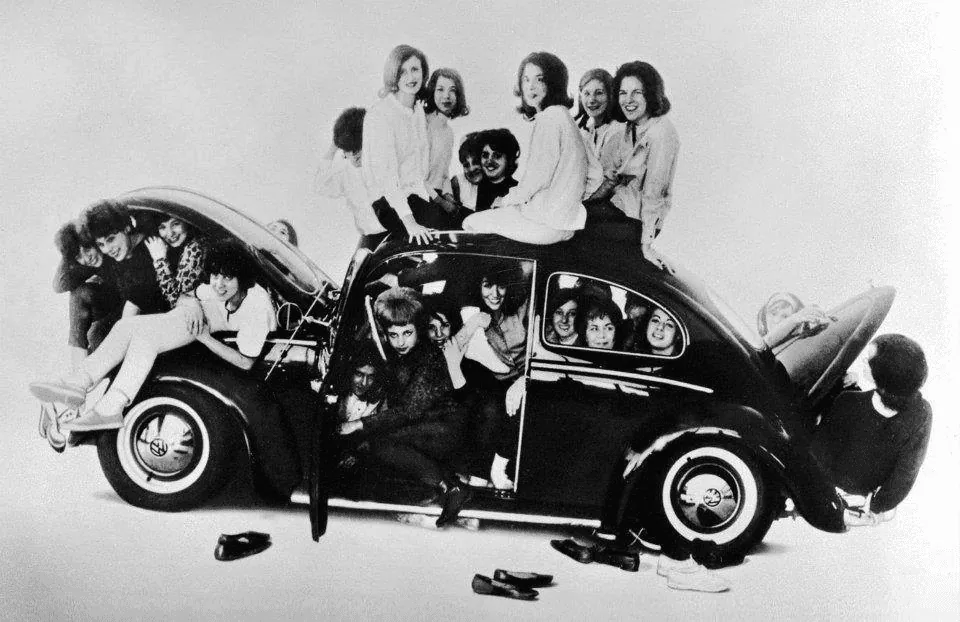
Quite a few modifications have been introduced to magical motorcars over the years. Most infamously, perhaps was in 1964 when fifty-seven young aurors and magical law enforcement officers were seen by Muggles to exit a Ministry modified Volkswagen Beetle near the Queens Head in Picadilly Circus. This particular motorcar had recently been fitted with a powerful interior expansion charm making it much larger on the inside than on the outside. |
Curiously, the Head of Magical Accidents and Catastrophes did nothing to reprimand the miscreants. Several concerned magical citizens wrote to the Daily Prophet in alarmed protest. While it caused quite a scandal at the time, it appears to have actually been a Ministry approved stunt, for the image became a rather famous advertising campaign for Volkswagen. Needless to say, later Ministry officials have sought to mitigate the damage done and have increased security measures as regards allowing Muggles to witness magic in this way.
* * *
Two other well known modifications, though by no means common, are the
flying circuit and the
invisibility shield. The latter, while complex magically speaking, as it interferes with and redirects the underlying physics of light, is really nothing more than implementing the same suite of spells as one would use when fabricating a cloak of invisibility.
The flying circuit is, though composed of far simpler spells --- levitation charms, motion charms, etc --- far more complex in its implementation. The car itself must be married to a magical framework of binding spells and control charms that allow the vehicle to fly in the air in all directions, speeds and also have the ability to hover. This complex of spells must be made to integrate with several other frameworks of spells that connect the various control knobs, steering wheel, gear shifting lever and pedals to the movement charms.
* * *
One modification that is becoming popular again among Muggleborns and Halfbloods in particular is the camping modification. Most wizards are familiar with the magical tent. They provide ample space for comfortable magical camping. After all, why muck about in the mud when one may rough it in a common with the magical tent, with its three bedrooms, a kitchen and a living room!
|
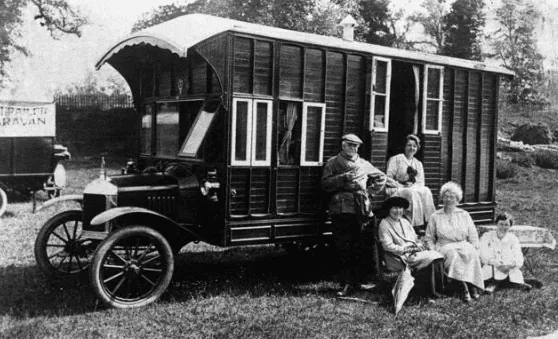
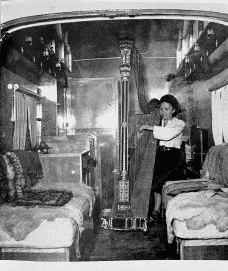
Minister for Magic Archer Evermonde, who held the office between 1912 and 1923, was rather fond of touring around in his wood paneled travelling van. It is said that he never went anywhere without his private herb garden, a well stocked wine cellar, and his own harpist who played from a small concert hall just off the van's parlour. |
Such conveyances had a similar appearance to the muggle vehicles of the time. As all of these were constructed by their owners, their outward appearance varied greatly. Wizarding folk were for the most part very careful about concealing the magic within. One way of maintaining magical anonymity that was quite popular in those days was to copy the style and decoration of the
vardos in use by the Travellers. Muggles already considered Travellers to be suspicious and possibly magical. They were generally avoided and many wizarding folk found their separateness to be a kind of kinship. In any event, patterning early magical camping vans on the
vardo proved to keep all but the most persistent of Muggles away.
In modern times, wizarding folk seem to have gone back in the other direction, opting to choose old beat up Muggle vans to modify. Ironically, these attract relatively little attention simply because they are so dumpy on the outside that no one pays them any mind! Nevertheless, the wizarding mind is ever seeking after improvements to its magical constructions!
Here we can see what appears to be an ordinary Volkswagen bus. However, once the charms laid on the bus are activated we can see many interesting features! We are told that this particular gem from Devonshire, sports no fewer than four magical tents, two of which are plainly visible at the front. Behind that is an astrological observatory, then a garden and lastly a beach at the very back with a very cheery parasol waiting to offer some shade on a sunny day! Above all and towards the left of the camper van, we are told, is a private broom racing course. The owner assures us that flying through all the rainbow colours as sunlight passes through the translucent walls is "bloody good fun!"
* * *

Many wizards, and some students perhaps, are familiar with the Knight Bus. The concept of a magical omnibus dates back to 1865 and has remained a convenient mode of transportation for the travelling wizard or witch, regardless of the bad press such "mugglery" gets in the Prophet. Its three levels offer ample seating and comfortable sleeping quarters for all its passengers. These busses are modified AEC Regent III RTs, given an extra level, and also given a number of magical modifications.
Notably, the Knight Bus travels at high speeds. Very high speeds. A number of spells were devised specifically for the bus line: in particular, intertial dampening and gravitational force reducing spells are in place that allow passengers to make sharp angled turns at over 100 m.p.h. without being tossed about too badly.