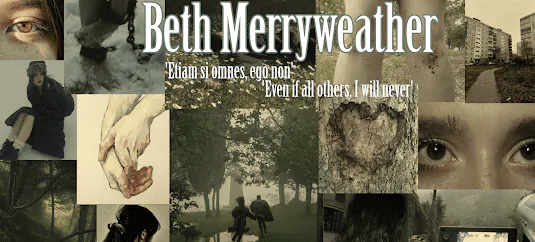
Beth Merryweather grew up in the heart of a council estate on the rough edges of East London, where life was anything but quiet or unremarkable. The estate was a maze of identical concrete blocks, their exteriors streaked with grime and graffiti, and the faint smell of damp clung to the air no matter the season. The stairwells were cracked, the lifts were always out of order, and the nights were punctuated by the sound of arguments spilling out of open windows or the occasional wail of a police siren. It wasn’t uncommon for Beth to spot an abandoned mattress tipped over in the street or to overhear whispered warnings about so-and-so’s older brother who’d just been let out of prison.
Her family—her mother, Jane, and her father, Thomas—lived in a tiny, cramped flat on the third floor of one of those blocks. The wallpaper in their living room was peeling, the floorboards creaked with every step, and the kettle only worked if you smacked it just right. Their second-hand furniture sagged under years of use, and the radiators were more decorative than functional during winter. It wasn’t much, but it was home.
Her parents worked hard to keep life as normal as possible, though there was no disguising the constant shadow of their financial struggles. They lived on benefits, and Thomas took on odd jobs when he could—fixing cars, painting walls, shifting furniture for the neighbors—to scrape together enough to get by when the dole wasn't enough. Beth wasn’t oblivious; she saw the thin envelopes marked with red ink that her mum hid in a drawer, and she knew what it meant when her dad spent too long staring at the electricity meter. But her parents had a way of making do, of laughing at the ridiculousness of it all, and they refused to let their circumstances crush them. It wasn’t glamorous, but there was a certain pride in their scrappiness, in the way they got through each day together.
She could still see it clearly: a thick envelope of cream-colored parchment with her name written in looping emerald-green ink. Miss Beth Merryweather, The Smallest Bedroom, 15 Duxbury Tower, East London. It was official and weighty in a way that didn’t belong to her chaotic, patched-together life. She’d stared at it for what felt like hours, her mind racing. Why her?
Sure, her mum had once admitted she used to be a witch—years ago, before she “gave it all up to marry your dad”—but Beth had never thought it mattered. Magic was something Jane had tucked away, like an old photo album that no one looked at anymore. It had no place in their cluttered flat or their day-to-day scramble to get by. And Beth? She wasn’t magical. She was Beth. Poor, scruffy Beth with her patched-up trainers and a knack for avoiding her parents’ attempts to brush her hair.
Though, it wasn’t the confirmation of magic that unsettled her. It was the idea that this life, this estate, this family she knew so well—this world—might not be all there was for her. The thought was thrilling and terrifying all at once.
But Beth wasn’t the type to let anyone see her sweat, even when no one was looking. She folded the letter carefully and set it down on her nightstand, leaning back against the peeling wallpaper. She wasn’t sure what to make of it all yet, but she knew one thing: she’d face it the same way she faced everything else—with her head high, her shoulders squared, and a quiet determination that no one could touch.
Magic or no magic, Beth Merryweather wasn’t about to let the world knock her down. She might have been a girl from a rough council estate with a cracked telly and a broken kettle, but she was also the kind of girl who could look the world in the eye and not blink. If Hogwarts wanted her, fine. She’d go. But she’d do it on her own terms.
First Instance of Magic:
Reducio
The first time Beth’s magic revealed itself, she had just turned ten, and it happened on an ordinary, unremarkable evening in their scruffy little living room. The room itself was as humble as the rest of the house—mismatched furniture softened by years of wear, an old coffee table scarred with the rings of where many cups of tea had lain, and the faint smell of toast that always seemed to linger no matter how much her mother cleaned. In the corner, their tiny television sat precariously on a wobbly stand, its rabbit-ear antenna bent at an odd angle. The set had seen better days, but it was the heart of their evenings, a rare source of shared entertainment.
Beth had been perched on the lumpy sofa, one leg tucked underneath her as she squinted at her homework—some muggle primary school assignment involving a particularly cruel bit of long division. To her right, her dad was flicking through a tabloid newspaper, muttering under his breath about football scores, while her mum sat with a mug of tea, knitting something that looked more like a tangled mess of yarn than an actual scarf. On the TV, an animal documentary played, the narrator’s soothing voice talking about penguins huddling against the cold. Normally, Beth loved these programs; they were her favorite way to unwind after a long day. But not this time. The numbers on the page in front of her refused to make sense, and the more she tried to force them into order, the more frustrated she became.
Her pencil pressed harder against the paper until it snapped, the jagged tip flying onto the floor. A surge of hot, bubbling annoyance rose from her stomach and shot straight to the top of her head. “Ugh, I hate this!” she groaned, tossing her head back dramatically. Her parents, used to her usual flare-ups, barely glanced up. But something strange happened when her gaze flicked angrily from her workbook to the television.
With a loud crack, the television wrenched itself from the wall as though an invisible hand had yanked the plug from the socket. The power cord flailed wildly for a second before the whole thing crashed to the floor, the screen shattering into a web of jagged cracks. The documentary narrator cut off mid-sentence, replaced by stunned silence in the room. Beth’s pencil clattered to the floor, forgotten, as her wide eyes darted between the broken TV and her parents.
For a moment, no one moved. Then Jane, her mum, let out an earsplitting squeal, leaping from her chair with the kind of energy Beth usually only saw when her mum found a bargain at the charity shop. “She’s a witch!” Jane cried, clapping her hands together like a giddy child. “Oh, my baby’s got magic! Just like her mum!” She swept Beth into a tight, smothering hug, rocking her side to side as if this was the greatest thing that had ever happened. Beth, however, was too stunned to speak.
Thomas, her dad, was far less thrilled. He lowered his paper and stared at the wreckage of the TV with the kind of weary resignation that came from years of putting up with life’s minor catastrophes. “Bloody brilliant,” he muttered, scratching his head. “How am I supposed to fix that?” He crouched down to examine the damage, shaking his head at the shattered screen.
In the end, "fixing it" meant slapping some electrical tape over the cracks and propping the whole thing against the wall at an awkward angle. The television worked after a fashion, though the picture was forever marred by a spiderweb of lines that distorted faces and made everything look like a modern art painting. The sight of it made Thomas grumble every time he saw it, but Jane loved telling the story. She would beam with pride, calling it the “first sign” of Beth’s magical potential.
Beth, on the other hand, wanted nothing more than to forget the whole incident. She spent the rest of the night avoiding her parents’ eyes and sneaking cautious glances at the broken TV, half-convinced it might come back to life and blame her for its misfortune.
Description:
Reducio
At twelve years old, Beth Merryweather cuts a striking, if diminutive, figure. Standing at a modest four feet eight, with a slim frame inherited from her mother, she carries herself with a confidence that almost compensates for her small stature. Almost. Her height—combined with the condescending looks it often earns—used to rankle her deeply. She loathes being patronized, her sharp tongue quick to remind anyone foolish enough to try. These days, however, she wears a mask of casual indifference, an air of "nothing bothers me" so practiced it almost feels true. Almost. Deep down, the simmering frustration of “little man syndrome” lingers, though Beth would sooner eat her own wand than admit it.
Her cockney accent cuts through any room she’s in, sharp and unapologetic, full of dropped H’s and glottal stops, giving her an edge that’s both disarming and unmistakably hers. Beth speaks like she owns every conversation she’s in, and she’s quick to turn that charm into cheek when the mood strikes.
She has the delicate features of an English rose, though there’s nothing dainty about the way she carries herself. Pale skin and rosy cheeks are dusted with freckles across her nose, and her raven-black hair—usually yanked back into a ponytail—never quite stays put. By day’s end, it’s always half-loose, falling around her face in defiant little tufts, as though rebelling against her half-hearted attempts at tidiness. Her small dimple, visible when she allows a genuine smile to slip through her otherwise guarded exterior, is a rare sight—much less common than her trademark smirk, equal parts teasing and defiant.
Beth doesn’t give a toss about appearances, unusual considering the airs and graces her house is known for. Her Slytherin robes are perpetually rumpled, her shoes are scuffed, and her knees are almost always sporting fresh scabs from whatever mischief she’s thrown herself into that week. She’s the type of kid who’ll try most anything for a laugh, from climbing trees just to see how high she can get to sneaking into places she shouldn’t be, all in the name of fun. "Go on, I dare ya," being her battle cry, even if she’s the one daring herself.
Despite her scruffy exterior, Beth has the cleverness her house is known for, though she wields it in her own chaotic way. She doesn’t plot grand schemes or chase glory; instead, she uses her sharp mind to read people like books. It’s a talent she uses both to entertain herself and to keep others at arm’s length. With a sly grin and a perfectly-timed jab, she can have most second-guessing themselves, and she revels in the power it gives her. But behind her cutting wit is something quieter—an insecurity she refuses to name, a fear of being truly seen for who she is. Her jokes and bravado are a smokescreen, hiding the part of her that wonders if she’s enough. Poor povvo Beth.
Beth’s tough-girl act extends even to her health. Anaemia be damned—she refuses to take her medication, claiming her body will "sort itself out" because, in her words, she "ain’t made o’ glass." She clings to the memory of the one time she powered through a fainting spell, wearing it like a badge of honor, while conveniently ignoring the countless times she’s crumpled to the floor. Her stubbornness is a hallmark of her personality: she’d sooner argue with a wall than admit she might need help.
Stubborn, fiercely independent, and quietly insecure, Beth isn’t the kind of girl who makes friends easily. She doesn’t trust easily, either, hiding her vulnerabilities behind a wall of irreverence and mischief. But beneath the bluster and bravado, there’s a passionate, determined spirit—a girl who’s as likely to push people away as she is to fiercely protect those who manage to stick around.
Last edited by Beth Merryweather on 15 Dec 2024, 16:34, edited 5 times in total.
Etiam si omnes, ego non.
Even if all others, I will never.